

by Jamie Parker-Ward
Christmas and the days around it hold a symbolic importance as a moment of transition. In Christian theology, it is the moment that God becomes man in the form of Christ, who would later bring salvation to all. It is no wonder then that Christmas was often picked as the date for similar moments of transition. One of the most famous instances is the coronation of Charlemagne on Christmas Day in 800 A.D. at Aachen.[1] King William I of England would later mimic Charlemagne by hosting his coronation on Christmas Day 1066, representing the beginning of Norman rule in England.[2]

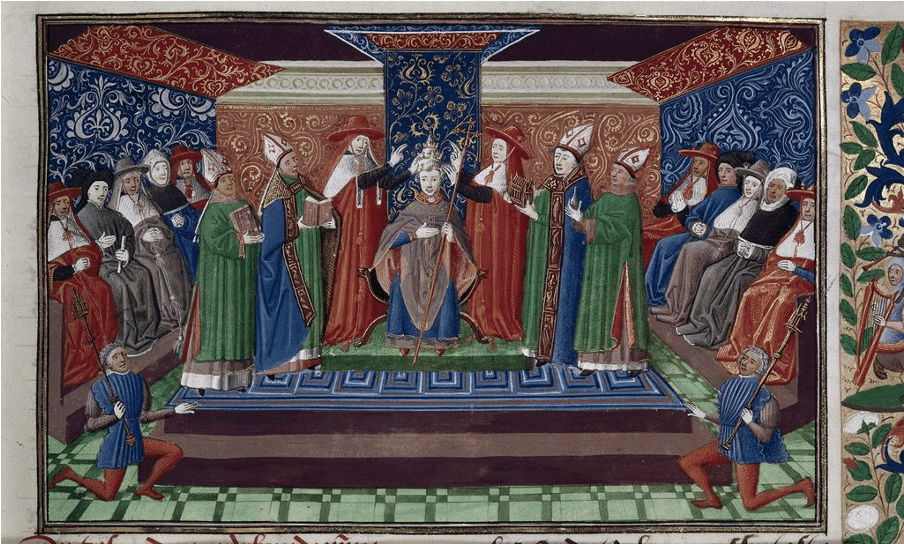
On 24 December 1294, Benedetto Caetani, born into a noble family in Anagni near Rome, was elected Pope Boniface VIII.[3] He succeeded the later canonised Pope Celestine V, who had resigned from the office after a brief 5-month spell in charge.[4] Celestine was not the first papal resignation. Benedict IX had resigned twice in the eleventh century, including one occasion on which he was bribed to sell the office.[5] But with the exception of Gregory XII, who resigned to end the Western Schism in 1415, no other Pope would resign until Benedict XVI in 2013.[6] One can probably sense the hope and excitement that came with Boniface’s election at such an important time in the Christian calendar.
It would be misplaced. Boniface VIII’s Pontificate would end disastrously after he was imprisoned by a group of men led by Guillaume de Nogaret, chief minister to King Philip IV of France.[7] Boniface would escape but would die soon after.[8] Philip IV would attempt to have Boniface denounced as a heretic, efforts which thankfully for the Papacy failed.[9] But Boniface VIII is still regarded as representing the end of the so-called “Papal Monarchy”.[10] A transition from the height of the Papacy’s power to its nadir.
Despite this, Boniface VIII reminds us of the symbolic importance of Christmas as a time of transition. For a short moment on Christmas Eve 1294, there presumably was hope – hope that this new Pope might unite Christendom on the day before Christ was born.
[1] Rosamond McKitterick, Charlemagne: The Formation of a European Identity (Cambridge: Cambridge University Press, 2008), p. 96.
[2] David Bates, William the Conqueror (New Haven: Yale University Press, 2005), p. 258.
[3] Brett Whalen, The Medieval Papacy (Basingstoke: Palgrave Macmillan, 2014), p. 154.
[4] Walter Ullmann, A Short History of the Papacy, 2nd edition (New York: Routledge, 2003), p. 176-77.
[5] Ibid., p. 79.
[6] Ibid., pp. 300-1.
[7] Bernhard Schimmelpfenig, The Papacy, trans. James Sievert (New York: Columbia University Press, 1992), pp. 198-9.
[8] Ibid., pp. 198-9.
[9] W.M. Bowsky, ‘Clement V and the Emperor Elect’, Mediaevalia et Humanistica 12 (1958) 52-69, at p. 53.
[10] The debate over the utility of the term ‘Papal Monarchy’ is contested in Medieval Papal studies. For a positive view of the term see Colin Morris, The Papal Monarchy, (Oxford: Clarendon Press, 1989); Ullmann, A Short History of the Papacy. In contrast, those opposed to the term have often supported Ernst Pitz’s idea of ‘Rescript Government’, which posits that the Papacy focused on responding to the demands of petitioners. See Patrick Zutshi, ‘Petitioners, Popes, Proctors: The Development of Curial Institutions, c.1150-1250’, in Pensiero e sperimentazioni istituzionali nella societas christiana, 1046-1250, ed. Giancarlo Andenna (Milan: Vita e Pensiero, 2007) for a good treatment of the Rescript Government view. Atria Larson, ‘Introduction’, in A Companion to the Medieval Papacy, ed. Keith Sisson and Atria Larson (Leiden: Brill, 2016) provides a great overview of this debate.
 doinghistoryinpublic.org