

by Daniel Gilman (@DanielGilmanHQ)
The 80th anniversary of the end of the Nazi’s Siege of Leningrad came and went only a couple of weeks ago, on 27th of January, with little attention in much of the world. The protracted horror of this siege is one of the most intense tragic events in world history. The evolving memorialisation of the siege of Leningrad reflects the dynamic nature of public history, illustrating how the remembrance of such tragedies is influenced by shifting priorities and agendas.
As I read through the diary entries of its victims and survivors, I find that I cannot do justice to documenting, let alone understanding the trauma of this haunting nightmare.
Conservative estimates are that 670,000 died, while more recent research reveals the number likely surpassed one million.[i] With the city blocked off from supplies, and the temperature falling to minus 40 degrees, during the Winters more than a thousand people died a day through the twin horrors of hypothermia and slow starvation. Families watched their loved ones slowly and painfully fade away into death. Though the siege of Sarajevo (1992-1996) was longer, historian Anna Reid explains that the siege of Leningrad, was ‘the deadliest blockade of a city in human history.’[ii]
But efforts to manage how people perceive this tragedy emerge from the early days of the siege. Soviet newspapers spoke of it as ‘a battle,’ rather than ‘a blockade,’ and refused to use the term ‘siege’.[iii] Soviet newspapers minimised reports of suffering, focusing instead on individual acts of valour. They chose to report many stories of hunger in German-occupied Europe, and even ran a story about ‘how Germany’s rat population was starving.’[iv]
In the years following the almost 900-day siege, Soviet discourse seems to have largely downplayed memorialization, likely due to Stalin’s discomfort with the perceived failure to protect Leningrad. As historian Sarah Gruszka explains, ‘The local authorities tried to hide the extent of the crisis… above all because the Stalinist regime didn’t want to call into question its capacity to protect and provide for its own citizens.’
However, after Stalin’s death in 1953, a more open acknowledgment emerged, leading to the construction of memorials.
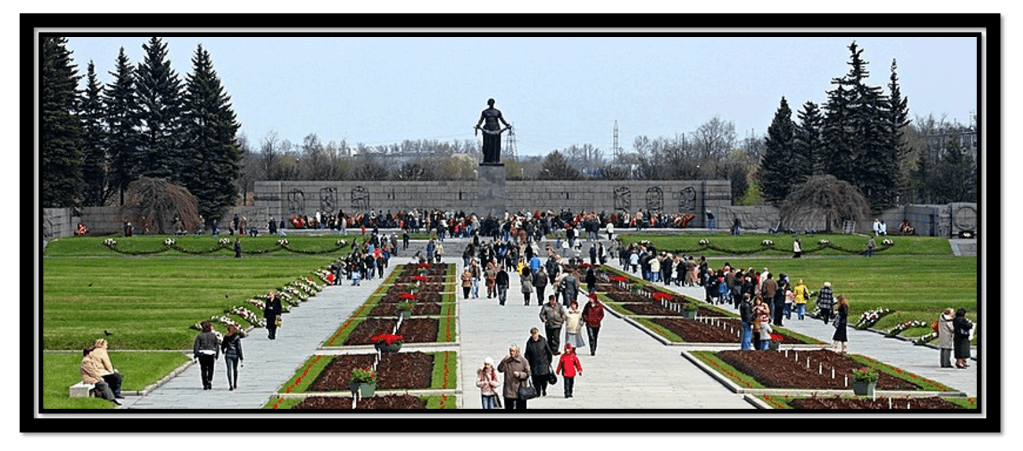
The primary site memorialising the siege is the Piskarevskoye Memorial Cemetery, opened in 1960. This memorial, housing the graves of approximately 420,000 civilians and soldiers, starkly symbolises the unfathomable immensity of the tragedy. Significantly, it features the words of Olga Berggolts, a poet and journalist who lived through the siege, and whose radio broadcasts provided solace to many during the blockade.
Her words, prominently inscribed at the Piskarevskoye Memorial Cemetery poignantly underscore the collective endurance and suffering of the Leningrad people:
Here lie Leningraders
Here are citydwellers – men, women, and children
And next to them, Red Army soldiers.
They defended you, Leningrad,
The cradle of the Revolution
With all their lives.
We cannot list their noble names here,
There are so many of them under the eternal protection of granite.
But know this, those who regard these stones:
No one is forgotten, nothing is forgotten[v]

Another beloved and famous expression of memorialisation is by the Leningrad Symphony, which performed during the siege, symbolising the resilient spirit of the city’s inhabitants.
In the post-Soviet era, there has been a marked shift in the narrative, with a greater focus on individual experiences of loss and the human cost of the siege. This is evident in the increasing attention given to personal memoirs, diaries, and stories of survivors, providing a more intimate understanding of the siege’s impact. This personalisation of memory aligns with a global trend in historical commemoration, where individual narratives are increasingly foregrounded to provide a more relatable and human perspective on historical events.
One of the most poignant reflections of this human tragedy comes from the diary of Tania Savitcheva, an 11-year-old girl whose simple yet heart breaking entries encapsulate the despair of the city: ‘Jenia died on December 28 at midnight. Grandma died on January 25 at three in the afternoon. Leka died on March 5 at five in the morning. The Savichevs are dead. Everyone is dead. Tania is all alone.’ Tania managed to escape the sieged city, but not long after died from exhaustion.
The initial downplaying of the severity of the siege has been clearly replaced by a cultivation of national pride in the resilience of the Russian spirit. More recent public memorialization focuses on this sense of resilience, endurance, and heroic defiance. As Alexander Nazaryan points out, Vladimir Putin was born in Leningrad, and has tied his own personal history to the city’s history.
The memorialisation of the Siege of Leningrad illustrates the evolving nature of public memory, shaped by changing political contexts and societal attitudes. It highlights the tension between national myth-making and local, personal experiences in the construction of historical memory. The siege remains a poignant reminder of both the horrors of war and the resilience of the human spirit, its commemoration reflecting the complex interplay between public and private forms of remembrance.
[i] Lisa A. Kirschenbaum, The Legacy of the Siege of Leningrad, 1941–1995: Myth, Memories, and Monuments (Cambridge: Cambridge University Press, 2009), 3.
[ii] Anna Reid, Leningrad: Tragedy of a City Under Siege, 1941-44 (London: Bloomsbury Publishing, 2011), 1.
[iii] Alexis Peri, The War Within: Diaries from the Siege of Leningrad (Cambridge: Harvard University Press), 35
[iv] Peri, The War Within, 34
[v] Kirschenbaum, the Legacy of the Siege, 205.
 doinghistoryinpublic.org