


João Moreira da Silva @moreiradasilvaj
Fifty years ago, the future was now in Portugal. Crowds stormed the streets of Lisbon to follow the fall of a fascist dictatorship at the hands of insurgent militaries; radios, televisions, and public buildings were seized; the premier surrendered; the war in the African colonies, such as Angola and Mozambique, was soon to be finally over. On the 25th of April 1974, the longest dictatorship in twentieth-century Europe was at last defeated, paving the way to a nineteenth-month period when the Portuguese people held the future in their own hands, conquering the rights that were denied by the regime for forty-eight years. During those months, the world had its eyes on the Portuguese Revolution, displaying either excitement or concern over one common question – was a real popular revolution unfolding in the West?
Portugal’s Estado Novo (‘New State’) emerged amidst Europe’s age of fascism, and it was no exception to it. Its most notable leader, the nationalist dictator António de Oliveira Salazar, rose to power as premier in 1933. Marcelo Caetano replaced him in 1968 – a time when the winds of revolution were already blowing from different directions. The Estado Novo’s ideology can be broadly understood as ‘Portuguese Fascism’.[1] Inspired by other experiences of fascism and nationalism in Europe, Salazar proclaimed a conservative trilogy that sought to guide the Portuguese nation and its citizens: Deus, Pátria, Família (‘God, Country, Family’).
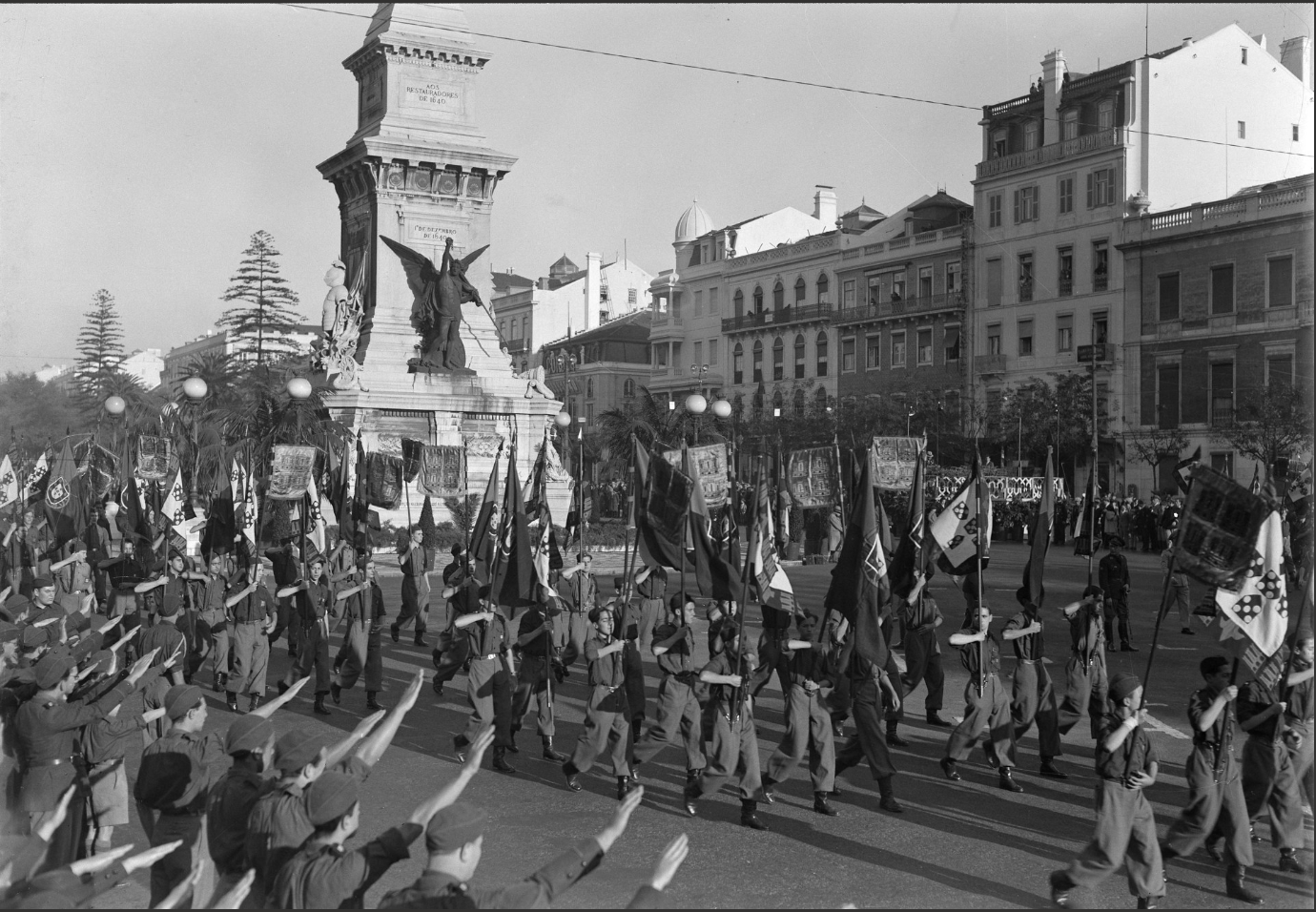
Drawing from this central trilogy, the one-state party regime presented itself as the saviour of the Portuguese nation, claiming to end the country’s ‘decadence’ through ideas of Catholicism and ruralism, therefore fulfilling the ‘mythical destiny’ of the country. The Empire, which encompassed the territories occupied by Portugal in Africa and Asia, was a central feature of this self-proclaimed destiny. As written in the 1930 Colonial Act, ‘the Portuguese Nation holds the historical purpose to colonise and possess overseas territories, and civilise indigenous populations.’ While exploiting African territories and their people – where forced labour and violent massacres against the indigenous populations happened recurrently until the fall of the regime – the Estado Novo created institutions in the metropole that displayed its resemblance to other experiences of fascism in Europe: military and paramilitary organisations that secured its hegemony; labour corporations which ruled the workers’ free time; propaganda spread by state machinery; censorship of oppositionist movements; youth nationalist organisations, such as Mocidade Portuguesa; torture, imprisonment and the persecution of political opponents.
Despite these mechanisms of power and oppression, the Estado Novo displayed a growing fragility over the years, in particular after the end of the Second World War. In 1958, oppositionist Humberto Delgado ran for President, promising to fire Salazar if he won, and enjoying great popular support. The elections were ultimately rigged. Delgado was forced to leave the country after he allegedly lost. However, his candidacy had long lasting effects on the regime. In 1961, the regime faced a number of threats, both at home and abroad – from the ‘Santa Maria’ hijacking, when Portuguese and Spanish oppositionists hijacked Portugal’s second largest merchant ship aiming to throw down the Iberian fascist regimes, to the loss of Goa, a colony ruled by Portugal for over 400 years, to India. Last, but not least, the first acts of violent anti-colonial resistance from African liberation movements took place in Angola, where the União das Populações Angolanas (UPA) conducted raids on the properties of white settlers, killing around 800 people.[2] Amid this crisis, Salazar reinforced the nationalist narrative and sent troops to Africa to fight against the African liberation movements. Over the following thirteen years, almost one million men – in a population of around eight million people – were sent to ‘fight for the nation’ in Angola, Mozambique, and Guinea-Bissau.
The long and bloody wars for African independences ultimately led to the fall of the Estado Novo. While the regime kept sending young men to Africa – many of them never coming back home – it repeatedly refused to accept the claims of independence of the liberation movements, ignoring the winds of history and the growing international pressure coming from the United Nations or the Vatican.[3] In this context of crisis and unnecessary bloodshed, a group of Portuguese junior military officers formed a movement, the Movimento das Forças Armadas, that revolved around one objective: to end the war and overthrow the regime. This was said and done. On the 25th of April 1974 the Movimento led a successful military coup that overthrew the regime and triggered a mass movement in the whole country. Born in Africa, where the struggle of African liberation fighters weakened the fascist regime over the years, the Portuguese Revolution had begun.

The nineteenth months that followed the military coup were characterised by a state of permanent revolution, when people took power by their own hands. The economy was nationalised; public freedoms were secured, the repressive apparatus from the dictatorship was destroyed; factories, land, and vacant houses were occupied; neighbourhood assemblies were formed to build new houses, schools, roads, and hospitals. Left-wing movements throughout the world watched with enthusiasm the events taking place in Portugal, where new forms of direct democracy were being created and people turned up almost daily to street demonstrations and parades.[4] The war in Africa was finally over, and meetings with leaders from Angola, Mozambique, São Tomé and Príncipe, Cape Verde, and Guinea Bissau began to take place. The empire was dismantled.
The dreams (or nightmares, depending on who was looking) of socialism in Western Europe were, however, not fulfilled. The first democratic elections, held in April 1975, where an impressive 92% of the population rushed to the polls, were won by the Socialist Party. This party aimed to construct a liberal democracy that resembled other states in the region, deepening Portugal’s ties with the European community. By November 25th, the ambitions of revolutionaries were permanently shattered, when a quick military operation disarmed the more ‘radicalised’ sections of the army, establishing the multi-party system that rules Portugal until this day. After almost two years, the Portuguese Revolution was over – but its memory is still celebrated, studied, and even contested on the 50th anniversary of the end of the dictatorship. While some continue to claim the promises of equality and justice that have not been fulfilled in democracy, heading to the streets of our cities on every anniversary of the military coup, others are enticed by a growing nostalgia for fascism and colonialism – a dangerous, and yet growing political trend in our continent.
Cover Image: Lisbon on the 25th April 1974 (Estúdio Horácio Morais)
Further Reading:
- Maria Inácia Rezola, The Portuguese Revolution of 1974-1975: An Unexpected Path to Democracy, Liverpool University Press, 2023
- Pedro Ramos Pinto, Lisbon Rising: Urban Social Movements in the Portuguese Revolution, 1974-5, Manchester University Press, 2013.
- Perry Anderson, ‘Portugal and the End of Ultra-Colonialism’, New Left Review 1, no. 15–17, 1962.
- Raquel Varela, A People’s History of the Portuguese Revolution, Pluto Press, 2019.
- Luís Trindade (ed.), The Making of Modern Portugal, Cambridge Scholars Publishing, 2013.
[1] Fernando Rosas, ‘Os Quatro Regimes’, O Século XX Português: Política, economia, sociedade, cultura, império (Lisboa: Tinta-da-china), 44-45.
[2] Perry Anderson, ‘Portugal and the End of Ultra-Colonialism’, New Left Review 1, no. 15–17, 1962.
[3] Aurora Almada e Santos, ‘From “Weak Presence” to Fait Accompli: the United Nations and the Portuguese Decolonization’, Revista Estudos do Século XX, 2018, pp. 115-133.
[4] Pedro Ramos Pinto, Lisbon Rising: Urban Social Movements in the Portuguese Revolution, 1974-5, Manchester, Manchester University Press, 2013.
 doinghistoryinpublic.org