

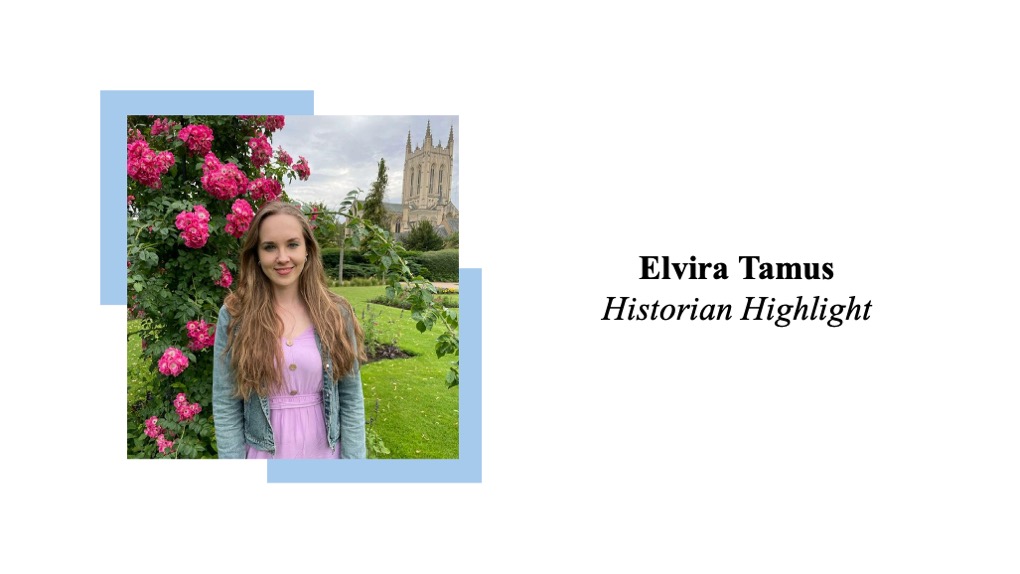
In the first Historian Highlight of Easter Term, Chris Campbell sat down with History PhD student Elvira Tamus to discuss her research, the New Diplomatic History, and the Global History Lab.
Elvira, let’s start by talking about your current research
I’m analysing the actors of sixteenth-century diplomacy, mainly looking at people who served the King of France and the King of Hungary at that time and pursued anti-Habsburg interests. It’s diplomatic history with a kind of ‘from below’ approach; instead of focusing on ‘high politics’, treaties, official documents, and so on, I’m interested in the diplomatic experience – what it was like to be a diplomat in this period. I look at the skills they had, the practices and services they performed, their social relations, friendships, personal conflicts, and their problems with travel, finances, and health.
How did you come to this topic?
When I was in my undergrad at Leicester, I was really interested in both the later middle ages and the twentieth century. Actually, for my BA dissertation, I researched the Holocaust and Jewish rescue activities. During my Master’s at Leiden, I became interested in diplomacy and the emerging school of the New Diplomatic History. The sixteenth century is the period when the Ottomans became prominent on the European political stage, so I found Christian-Muslim diplomatic relations fascinating too. For my PhD, I aspired to research a topic related to Hungary, which is where I’m from, and something in which I could use multiple languages, both in terms of the primary sources and the scholarly literature.
Diplomatic history can have a bit of an old-fashioned reputation these days – to what extent do you think of yourself as a diplomatic historian?
I feel like calling myself a historian of anything comes with a lot of responsibility in what I say! But, in fact, the very reason I became interested in diplomatic history was because of how this old-fashioned topic came to embrace the history writing of the social, cultural, gender and global turns. Daniela Frigo has this idea of ‘holistic’ diplomatic history – looking at the whole of diplomacy, with reference to how diplomats navigate changing social and cultural practices. I came across this during my Master’s, where we talked a lot about embassy chapels in the early modern period, the role of religion in diplomacy, and the agency ambassadors exercised in maintaining their own religious beliefs.
You look at very personal aspects of diplomacy – how are you able to find these in your sources, given that you can’t conduct oral history interviews?
It’s difficult because there’s a limited number of sources you can analyse, but maybe that’s the beauty of it. I look at a lot of correspondence between diplomats, along with diaries and letters that help me understand how their activities were perceived. Reports and financial accounts have also been useful. In this period, news and information circulate in really interesting ways. For instance, by looking at how people in Madrid write about what happens in Buda or in Istanbul – with the gossip and misinformation that comes out of that – I can improve my understanding of the diplomats’ personalities. It’s very interesting to see in some of my source material how some of the issues and themes that are so prevalent today were present even back in the sixteenth century. I have sources from an ambassador who complains all the time about his health, about how he’s fed up with war, and expresses his wish to retire somewhere warm to drink wine.
When looking at sources across such different countries, how accessible are they for researchers?
Thankfully, a lot of my sources have been edited and published, so I have quite a lot of edited volumes of diplomatic letters and correspondence. But I’ve done archival research in London, Paris, Brussels, Venice, and Budapest, and I plan to visit archives in Vienna and Simancas. So it’s a nice topic because it’s allowed me to travel through a lot of Europe, and I find touching all these old documents really exciting.
What are some of the scholarly approaches that have influenced your approach?
Anything that approaches politics and diplomacy through a fresh lens – again, social and cultural practices and issues. The global turn, particularly, has been really important to me; I’m very interested in the debates around global history and the uses of the term. I don’t look at many female diplomatic actors in my research, but I still find scholarship that deals with gender really useful for understanding how diplomacy can be seen from different perspectives.
You’re involved with the Global History Lab, with whom you’ve previously curated a series of essays on this blog. How does that fit into your PhD?
The Global History Lab is based in CRASSH, and it’s a new innovative form of teaching the history of the world between the late medieval period and today as well as qualitative research methods. In the programme, there are partners which are more traditional and ones that are in humanitarian emergency zones. For example, I’m teaching at the Sapienza University of Rome this academic year, and last year I taught South Sudanese refugees living in a Ugandan refugee settlement. It’s a lab because it’s very experimental, bringing together various institutions from several continents. In the qualitative research methods course, our students have the chance to learn about oral history, conduct interviews, and complete their own research projects.
And finally, what has been your experience of doing a PhD at Cambridge?
It’s been very inspiring. You meet famous scholars and talented people at the beginning of their careers, from all over the world. I think maybe people from outside Cambridge can be a bit intimidated by it, but I’ve met some of the most humble and supportive people here. The resources are incredible too, both primary sources and secondary literature. The Faculty of History provides its students with great research, teaching, and career development opportunities. I have also benefitted a lot from being a Research Assistant at the Centre for Geopolitics (CRASSH). So, for a PhD in History, Cambridge is the perfect place.
 doinghistoryinpublic.org