

Deposuit potentes de sede et exaltavit humiles
Tales of Puritan… well… puritanism, are usually a popular topic of conversation this time of year (especially among certain subsets of the population). Christmas in sixteenth and seventeenth century England was a rather sparse affair with fewer and fewer ‘lords of misrule’ and (ostensibly) more and more ‘cleaning-the-feet-of-the-poor-ers’.
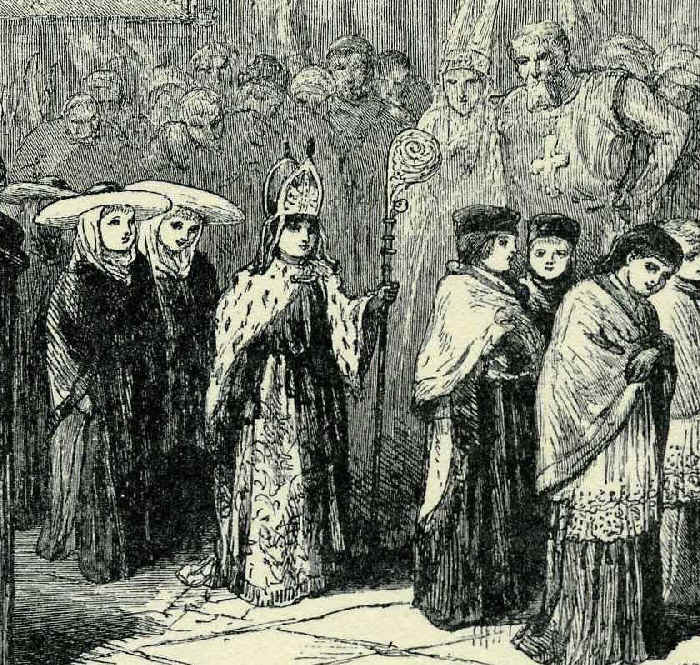
This most ‘pure’ of traditions stretches back to medieval times with the practice of ‘Royal Maundy’ where the King would wash the feet of beggars and is part of the grand history of Christmas reversals (re: Saturnalia leftovers). Another such reversal was the rather more modest ‘Boy Bishop’, where a boy, usually a chorister, would be elected to a bishopric on the Feast of St. Santa Claus, and hold the office until the Feast of the Holy Slaughter of Children (re: Day of Holy Innocents).
This child would be accompanied by a phrase (mentioned above in the obligatory latin), which translates to “He hath put down the mighty from their seat and hath exalted the humble and meek” — a sentiment with almost Old Testament charm. These boy bishops were meant to throw the Great Princes of the Church down from their seat, before meekly returning that seat on the 28th of December.
Our Puritans, though, saw this tradition as nothing more than a lot of Popish wickedry, so reversed the reveals with reversals on the reverse. Where once boys were made bishops and Kings washed manky feet, now the little folk washed little folks’ feet.
Perhaps it pays to remember that while some reversals can be mighty political statements, most are just silly, with a few that might actually be touching; but have too many of them, and you might just be back to where you started.
In the spirit of an ever backwards Advent, May Yuletide Sorrows ever be reversal-ed!
Illustration: ‘A medieval Boy Bishop attended by his canons’, https://en.wikipedia.org/wiki/Boy_bishop#/media/File:Boy_bishop.jpg
 doinghistoryinpublic.org
