

By Andreas Nabil Younan (any21@cam.ac.uk)
How does one write the political history of an authoritarian regime, where access to
state documents is restricted for national security reasons and censorship has been
widespread?
Egypt has been under strict military rule since the republic’s founding in 1952,
following a coup d’état by the “Free Officers” movement against the British-backed
monarchy. President Anwar Sadat (r. 1970-1981), a Free Officer, introduced a multi-
party system in 1976, and soon the new regime faced real parliamentary opposition
for the first time. Islamists of various factions—including the banned Muslim
Brotherhood—were allowed to run for parliament despite their primary goal of
dismantling the legal system and rebuilding it based on Islamic values, ultimately
aiming to rule by Islamic law. A story that largely remains untold.
Scholarship on politics in post-1952 Egypt has primarily relied on memoirs and
newspaper coverage, published mainly by state-controlled publishers that seldom
provided space for oppositional voices. In the late 1970s, during the so-called
“Islamic revival”, an Islamic press engaged in the struggle over history and the
political narrative, but only with limited success due to banning, censorship, and
imprisonment—especially after the assassination of President Sadat by militant
Islamists in October 1981. However, since at least 1924, every word uttered from the
podium under the dome of the Parliament has been meticulously transcribed in
“minutes” (maḍbaṭa, pl. maḍābiṭ), making it an invaluable—and, most importantly,
uncensored and unfiltered—source documenting parliamentary life. An interesting
case is law no. 63 from 1976 called “prohibition on alcohol drinking”, which is a
criminal offence punished with flogging in classical Islamic jurisprudence. The law
was considered the first Islamic law enacted. However, the law did not ban alcohol
drinking; it merely restricted it to hotels and other places with alcohol licenses, and it
allowed alcohol to be sold to foreigners. In practice, the ban was not enforced, and
liquor continued to be freely served to Egyptians. The minutes reveal that the original
bill, presented by Islamist Maḥmūd Nāfiʿ, sought a total ban on alcohol consumption,
but the regime ultimately prevailed in Parliament.
During the so-called “golden age of opposition”1 in the late 1970s, oppositional MPs
became increasingly aware of the pivotal role of the minutes in documenting their
struggle against a too-powerful opponent, the Egyptian regime. In the words of a
prominent figure, Maḥmūd al-Qāḍī, who, during a debate, said: “I am speaking for
the minutes and history”.2 In Islamist oppositional circles, it was widely believed that
state-controlled media deliberately kept their activities in Parliament under wraps,
and sometimes even twisted their words to defame them.3 They tried to counter the
media blackout, or the “silence conspiracy”4 , by publishing the minutes through the
Islamic press.5 One example is ʿĀdil ʿĪd, an independent MP from 1976 to 1979, who
pieced together his political memoirs, “The Minutes Speak”, using only excerpts from
the minutes. The book reveals that the debate on banning alcohol consumption
continued in 1977, with ʿĪd himself presenting a bill for a complete ban against
drinking, production, sale, and circulation.6 However, the bill was buried in one of
Parliament’s many subcommittees, a known regime tactic. In the book’s introduction,
ʿĪd, a lawyer, explained how the minutes serve as a “defence memorandum” in the
regime-led campaign against the opposition.7 His defence, however, proved
insufficient, and he ended up imprisoned together with more than 1500 other
oppositional figures in September 1981, an action many believe contributed to
President Sadat’s assassination a month later.8
The parliamentary minutes remain an inaccessible and untapped source that could
unveil the history of parliamentary life in modern Egypt and challenge the regime-
controlled narrative. Let the minutes speak, so that we can write history.
Notes:
- ʿAbd al-Samīʿ, Jamāl. 1983. Maḥmūd Al-Qāḍī: Najm al-ʿAṣr al-Dhahabī Lil-Muʿāraḍa Bi-l-Wathāʾiq
Wa-l-Shuhūd. Cairo: Tawzīʿ al-Ahrām. ↩︎ - Ibid., p. 72. ↩︎
- Rāḍī, Muḥsin. 1990. Al-Ikhwān al-Muslimūn Taḥta Qubbat al-Barlamān. Vol. 1. 2 vols. Cairo: Dār al- ↩︎
- ʿĪd, 1984, p. 4. ↩︎
- One example is Rāḍī, 1990. ↩︎
- ʿĪd, 1984, pp. 108-112. ↩︎
- ʿĪd, 1984, p. 4. ↩︎
- Ismāʿīl, Ṭāriq. 2016. ‘fī dhikrā qarārāt sibtambir: ʿādil ʿīd.. al-muʿāriḍ al-sharīf alladhī rafaḍa al-
wizāra’. al-Ahrām. 13 September 2016.
https://gate.ahram.org.eg/daily/News/192022/62/550697/الاسكندرية/فى-ذكرى-قرارات-سبتمبر–عادل-عيد–المعارض-
الشريف-ال.aspx. ↩︎
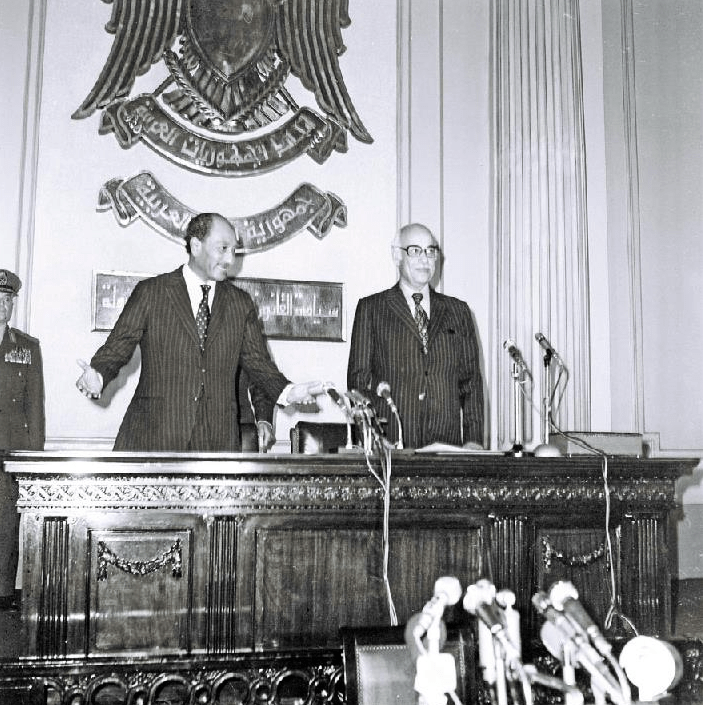
Image: Anwar Sadat-Egyptian Parliament-1977: https://commons.wikimedia.org/wiki/File:Anwar_Sadat-Egyptian_Parliament-1977_%2809%29.png
 doinghistoryinpublic.org
