-
4. Fragments of a Sacramentary

By Kate Falardeau (@kate_falardeau) The binding of a mid-ninth-century copy of Bede’s Martyrology (Würzburg, Universitätsbibliothek, M.p.th.f. 50) is material proof of the fragmentation and reuse of medieval manuscripts.[1] Four small strips of parchment (110 x 60 mm) from another manuscript have been used as waste, in this case to reinforce the spine of the codex.
-
7. A Book of Memory from Medieval Alsace

By Kate Falardeau (@kate_falardeau) Columns prop up a detailed architectural façade. To the left of the composition, the zodiac sign Capricorn emerges from a hypnotic spiral. To the right, a proclamation seems to be issued. The scroll, held by a ruler and an anxious looking man, actually contains a regimen to be followed during January…
-
12. A Boxing Day Retort

By Andi Schubert We find an indignant letter and record of communication between a certain P.A. and the then Archbishop of York, the Rev. William Thompson, in the 26th December 1874 issue of The Spectator.[i] In response to a sermon preached by the Archbishop, the letter protests the “undiscerning contempt or (worse still) the supercilious…
-
14. The Christmas Eve of 1647 in the Journal des Jésuites

By Weiao Xing (@WeiaoX) ‘On Christmas Eve, at night, we assembled as usual, that is to say, at half past eleven; we sang hymns and canticles […]’. In 1647 in Québec, a group of French Jesuits gathered, probably illuminated by candlelight, chanting a repertoire of sacred songs to celebrate Christmas. ‘At the end of Te Deum,…
-
11. Boniface VIII: A Christmas Pope
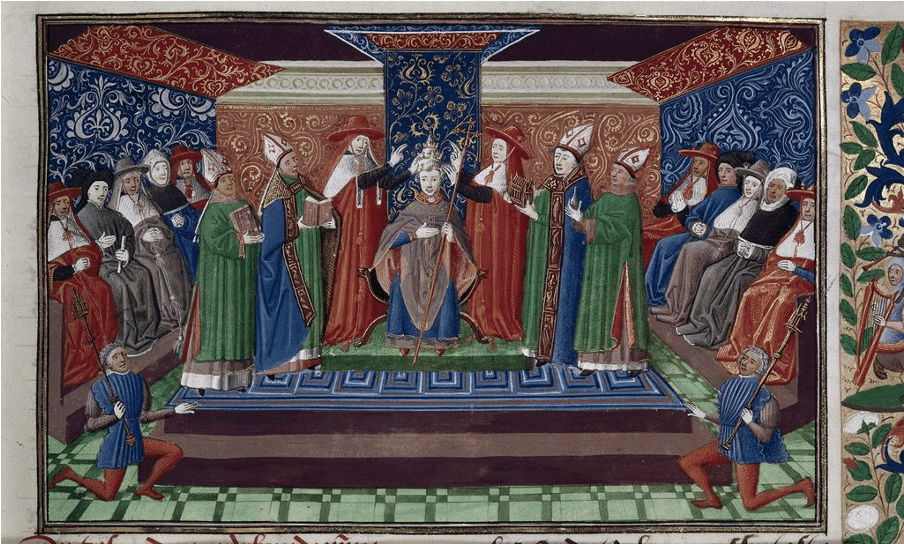
by Jamie Parker-Ward Christmas and the days around it hold a symbolic importance as a moment of transition. In Christian theology, it is the moment that God becomes man in the form of Christ, who would later bring salvation to all. It is no wonder then that Christmas was often picked as the date for…

 doinghistoryinpublic.org