

By Sietske van der Veen ( Twitter/X: @SBvanderVeen; Bluesky: @sbvanderveen.bsky.social)
The documentary Occupied City (De bezette stad,2023) contrasts everyday life in Amsterdam’s cityscape today, visualised in the moving images, with the horrors of World War II, described by the voice-over. Through this layering in sound and vision, the 4.5-hour film made by Steve McQueen and Bianca Stigter presents the viewer with the shrill break between past and present. Narrating a story of persecution and loss, it considers the Dutch capital a ‘guilty landscape’ (schuldig landschap). In the 1970s, the Dutch artist Armando coined this term for a seemingly peaceful site where terrible things have happened.
Occupied City does not exclusively focus on the Shoah (the Holocaust), but on the broader wartime history of Amsterdam. However, as ten per cent of the city’s pre-war population was Jewish, and the majority of them were murdered, Jews, and former Jewish sites, are often portrayed throughout the film. Moreover, during the war, locations within the old Jewish quarter and the Transvaalbuurt and Rivierenbuurt neighbourhoods, where many Jewish Amsterdammers lived, became designatedJewish sites by the German occupier. These places were forced upon Jews, and their spatial experiences were charged with a different meaning. The fact that Occupied City gives ample consideration to the Shoah makes it a testimony to the ever-evolving Dutch memory culture and the meanings attached to Amsterdam’s Jewish topographies in the past eighty years.
Read more: Imagining Jewish Topographies in Occupied CityThe film presents countless examples of the contrast between past and present. There is, for example, the Krugerplein in the Transvaalbuurt neighbourhood, where a group of men play pétanque, banter, and discuss tactics and points. Although a place of Jewish life during the 1930s, when Jewish men could just as easily have played games like these, the Krugerplein, as the voice-over also discloses, became a round-up place during the war. Another example are the headquarters of the ‘Jewish Council’ for Amsterdam at 58, Nieuwe Keizersgracht, with its spiral staircase. When the camera turns to basement level, one can almost envision the people who waited in line downstairs, desperate to obtain a Sperre, a temporary exemption from deportation. The building now houses, among other things, a yoga room and a music studio. In the opening shot of the documentary, the Sarphatipark in the snow is filmed right across from where Jewish painters Else Berg and Mommie Schwarz portrayed the winter landscape in 1942. A year later, after Berg and Schwarz were both murdered in Auschwitz, the park itself served as a round-up place during the last deportations. Finally, there is Amsterdam Central Station, where survivors of the Shoah met with a cold reception upon their return to the city. Refugees from Ukraine depicted in the film receive a warmer welcome in this same space over eighty years later in 2022. Largely filmed during the COVID-19 pandemic, Occupied City also offers some unsettling analogies between the two distinct time periods. For example, the first lockdown is announced on national TV by Prime Minister Mark Rutte just after the voice-over has spoken about “Jews prohibited” signs at the Rembrandtplein, a popular entertainment area to this day, and about the official ban of Jews from cafés, bars, and restaurants in September 1941.
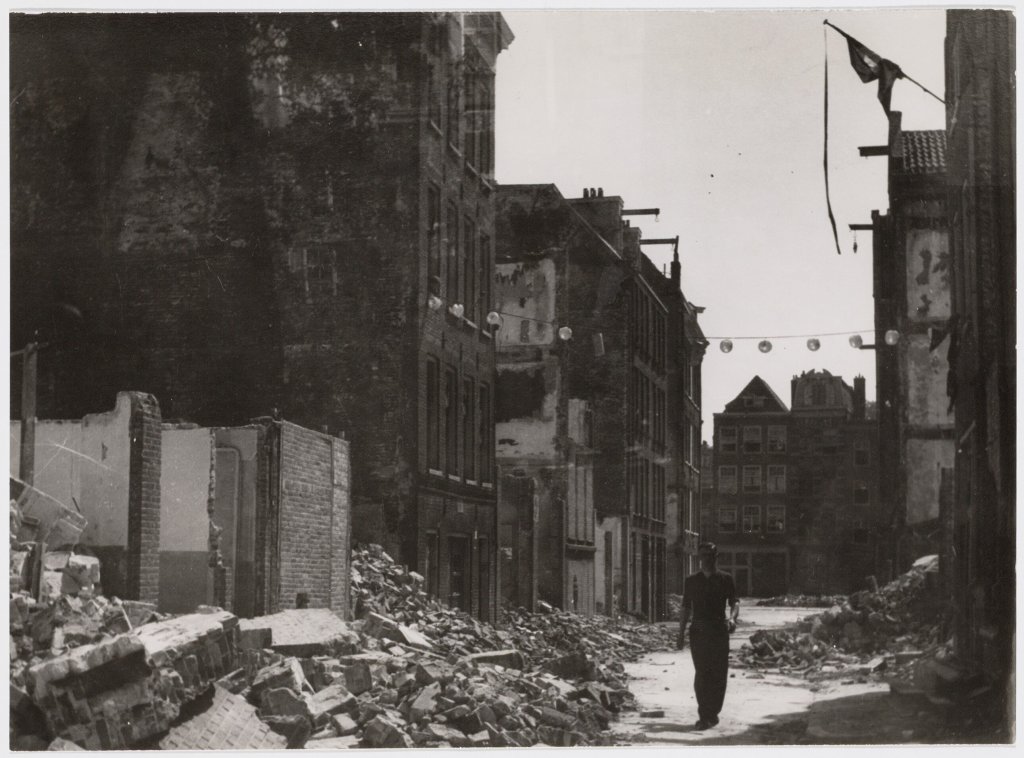
After the last of Amsterdam’s Jews were deported at the end of September 1943, many Jewish homes and businesses in the former Jewish district fell into disrepair. Private properties and communal buildings were looted, vandalised, or turned into rubble, particularly in the Hunger Winter of 1944-45. When survivors of the Shoah returned to the city after the liberation in May 1945, they often had to cope with unwilling and sometimes even hostile fellow citizens, as well as with a distant and formal municipality. The role of the current authorities in looking after the interests of Jewish Amsterdammers is exemplified by Femke Halsema, the Mayor of Amsterdam, who features in Occupied City several times. It is a far cry from the wartime and post-war conduct of the local government, as becomes evident from my own research into post-war Jewish Amsterdam. Multiple sources in the municipal archives demonstrate how the municipality mainly regarded the destruction of war as an opportunity to carry out its far-reaching plans for urban renewal.
Urban redevelopment irreversibly changed the face of the former Jewish quarter in Amsterdam from the 1960s onwards. A general culture of commemorating the Shoah emerged in the Netherlands, as elsewhere, when victims were increasingly acknowledged. As the Holocaust became a moral touchstone, many former places and spaces of Jewish life in Amsterdam, as in other European cities, became part of the city’s spatial pattern of commemoration, or the topography of memory. Occupied City can be seen as corollary to the development of this memory culture. The filmshows several memorial sites, such as the National Holocaust Names Memorial at the Weesperstraat, and numerous Stolpersteine (‘stumbling stones’), as well as the ceremonies now taking place there. Additionally, by visualising various other places within the urban landscape without visible markers of the wartime past, the film itself also memorialises space. Moreover, with its matter-of-fact “demolished” or “partly demolished” statements, Occupied City evokes questions not only about the different meanings we attach to the same sites over time, but also what happens if certain places are actually no longer there.
This blog is an edited and abbreviated version of a lecture given at the symposium ‘Sounding the Spaces of Historical Experience: Remapping the Cinema of the Holocaust,’ 17 May 2024, Royal Holloway, University of London.
References:
Steve McQueen and Bianca Stigter. (2023). De bezette stad (Occupied City).
Image: Destruction in the Jewish quarter, August 1945. Collection Amsterdam City Archives.
 doinghistoryinpublic.org