

By Marlo Avidon (@MarloAvidon)

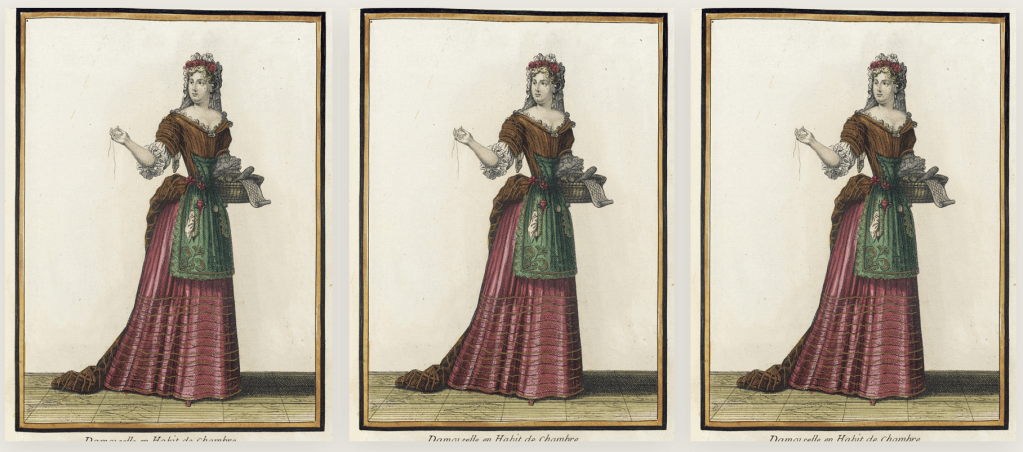
In the nearly two centuries between the decline of the sixteenth-century costume book and the rise of the late eighteenth and nineteenth-century fashion plate, the late seventeenth century experienced a brief resurgence in printing images of contemporary dress.1 Created almost exclusively in France and either depicting ambiguous, unnamed mannequins known only as dames and hommes de qualité or fictionalised representations of court celebrities, these images were disseminated across Europe and were a vital tool in asserting Louis XIV’s cultural hegemony and promoting Francophile styles.2
While few references explain who purchased these prints, it is clear that they were particularly popular amongst women. Evidence suggests that they saw the prints not only as a tool for gathering knowledge on the current modes, but a distinctly feminine form of recreation by colouring and embellishing the prints. Indeed, in 1666 the English diarist Samuel Pepys recorded visiting his local print-seller ‘to buy some prints for my wife to draw by this winter.’3 While it is unlikely that these were fashion prints, as the genre did not become commonplace until the 1670s, Pepys’s large library of prints features numerous hand-coloured fashion illustrations in an obviously amateur hand.4 These were likely completed by Pepys’s live-in mistress Mary Skinner, who was praised for her artistic abilities.5 Within the library, there are even several duplicate prints, one featuring hand-colouring and the other in its original form. This suggests a keen interest amongst cultured seventeenth-century men and women in collecting, preserving, and decorating fashion prints.
Yet Pepys and his family were not exemplary in this regard. Museum collections including the Los Angeles County Museum of Art and Victoria and Albert Museum include various examples of decorated fashion prints; many are even embellished with scraps of fabric and ribbon.6 For educated women, the enhancement of these prints not only brought them closer to the latest contemporary fashions, but also provided an opportunity for them to refine their artistic skills and create decorations that could be varnished or framed to adorn the walls of their homes.
References
- On the history of and process of creating seventeenth-century fashion prints see Kathryn Norberg and Sandra Rosenbaum, eds., Fashion Prints in the Age of Louis XIV: Interpreting the Art of Elegance (Lubbock, 2014). ↩︎
- On the role of fashion prints in disseminating contemporary dress see Elizabeth Davis, ‘Habit de qualité: Seventeenth-Century French Fashion Prints as Sources for Dress History’, Dress, 40 (October 2014), pp. 117–143. ↩︎
- Samuel Pepys, Diary Entry from 7 November 1666, accessed via https://www.pepysdiary.com/diary/1666/11/07/ ↩︎
- On Pepys’ collection of fashion prints see Diana De Marly, ‘Pepys and the Fashion for Collecting’, Costume, 21 (January 1987), pp. 34–43. ↩︎
- Claire Tomalin, Samuel Pepys: The Unequalled Self (London, 2012), p. 284. ↩︎
- Diana De Marly, ‘Pepys and the Fashion for Collecting’, Costume, 21 (January 1987), pp. 34–43. ↩︎
 doinghistoryinpublic.org