

By Loong Dien Min, @dmloong
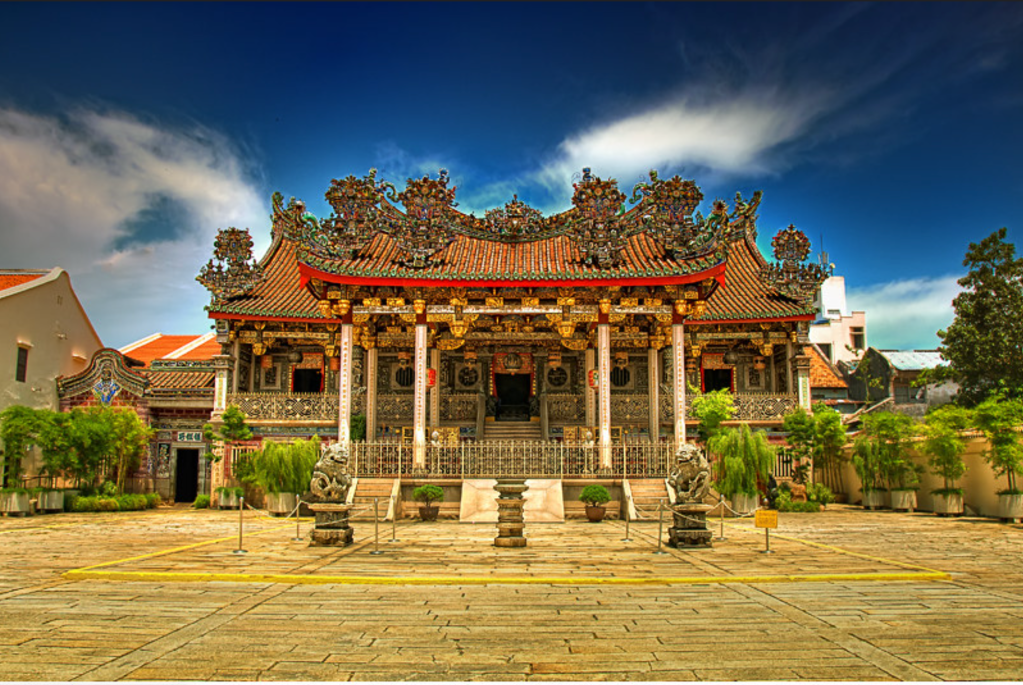
Cover image: Leong San Tong Khoo Kongsi, or Khoo Kongsi Clan House in Georgetown, Penang. Elwiz Low. 2013. https://www.flickr.com/photos/55317041@N02/7854424908/

In 1851, while the first documented wooden Advent calendar was being crafted in Germany [1], the island of Penang, situated 5260 nautical miles away, witnessed the inception of the Leong San Tong Khoo Kongsi. While the Khoo clan has its roots in Southern Fujian, China [2], the architecture of the Khoo Kongsi complex in Penang intricately weaves together various cultural elements, skillfully negotiating new notions of belonging. This integration reflects the dynamic transregional flows of people and ideas that have left their mark on the island.

Upon entering, one is immediately greeted by the “Anglo-Chinese urban vernacular” facade of the building. Embracing the eclectic decorative styles that gained popularity in the late Victorian era, the structure embodies the Sino-colonial essence of 19th-century multifunctional shophouses. The building, painted in auspicious red according to Chinese cultural traditions, features European-influenced louvre windows adorned with Palladian-style fanlights and arched French windows. The exterior wall showcases European-style plaster bas relief stucco patterns, and the capitals of Corinthian-Doric columns are ‘sinocized’ in both motifs and color [See Figures 1 and 2 below].


Additionally, two murals at the recess porch depict the three Chinese symbols of good fortune: the snow deer symbolizing prosperity, the crane representing peace, and the pine signifying longevity [See Figure 3 below].
What intrigued me the most were the lattice door panels, with a translation of Mandarin phonetic borrowing into Malay fretwork. Upon close inspection, one can discern carvings depicting a vase (瓶, ping) of flowers positioned on a surface (案, an) at the center-left of the panel. The combined phonetic sound of these two characters yields the meaning of 平安 (Píng’ān), signifying ‘safety’ [See Figure 4].

The Khoo Kongsi building effectively showcases a compromise among English, Malay, and Chinese architectural styles. It serves as a vivid embodiment of the Khoo clan’s simultaneous efforts to preserve cultural authenticity while embracing the transregionalism of its contemporaries in the mid-19th century.
References:
[1] Wakelam, A. (2015). The history of Advent calendars. https://doinghistoryinpublic.org/1-advent-calendars/
[2] Khoo Kongsi. Origins of the Khoo Clan in Sin Kang. https://www.khookongsi.com.my/history/origin-of-the-khoo-clan-in-sin-kang/
[3] Lee, H.Y. (2003). The Singapore Shophouse: An Anglo-Chinese Vernacular. Asia’s Old Dwellings: Tradition, Resilience, and Change (Knapp, R.G. eds.). New York: Oxford University Press, pp.115.
[4] Loong, D.M. (2021). Field Visit Report of the Leong San Tong Khoo Kongsi. Submitted to University of Nottingham Malaysia. pp. 3-4
 doinghistoryinpublic.org