

David Martin (daim3@cam.ac.uk / Bluesky: @davidmartin8293.bsky.social)
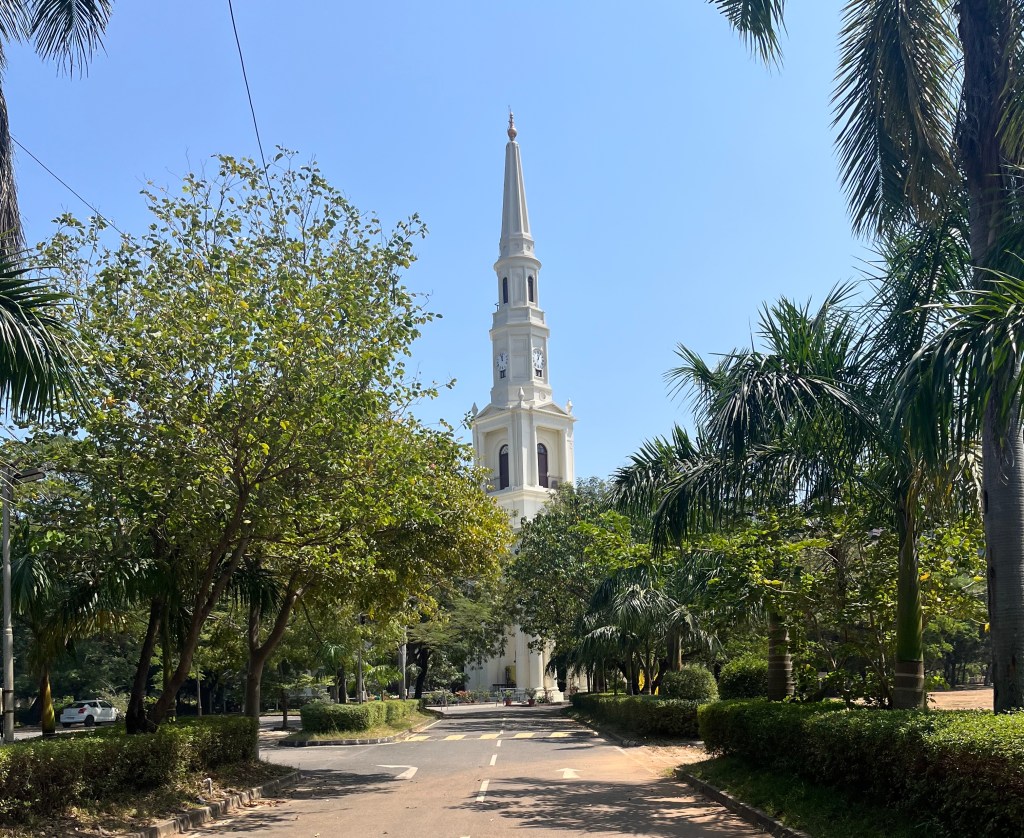
Auspicio Regis et Senatus Angliae — the words stand bold on the façade of St. Andrew’s Church — the Kirk, a reminder of a time when these structures were erected by the grace of kings and the elder statesmen. These were monuments as much to themselves as to the god they served. Forty-eight pillars, a lapis lazuli dome, rococo stained-glass windows and a spire that shoots to the stars enclosed the pious presbyterians in a circular nave. For most of its two-hundred years of existence, this Kirk attracted Scots from every corner of the world to its reformed worship. Originally built at the centre of a nearly nine-acre plot, this blazing white church was built to demonstrate presbyterian grandiosity to anyone who drove up its spacious avenue flanked by Palmyra trees.
Palmyra trees?
Read more: An Andrean PostcolonialPerhaps not the most Scottish Borassus in the world, but a much loved symbol of Christianity in Southern India, where this church is located. Often considered a marvel of nineteenth century architecture and the most ‘perfect daughter of Trafalgar Square’, the affectionately termed Kirk has had a storied history since its foundation in 1818. It was based on the august premises of St. Martin-in-the-Fields (hence the Trafalgar connection) with a liberal dollop of inspiration from St. George’s, Dublin (which is its only rival for the title of ‘perfect daughter’).
Its earliest memorial plaques commemorate the Church’s founders and first custodians — Major Thomas de Havilland, Colonel James Caldwell, Rev. James Jollie, and a good number of men and women who formed part of the erstwhile ‘Caledonian Society of Madras’ — standard colonial memorials for those who travelled half way around the world to turn a profit. These, together with their more famous North Indian counterparts like Alexander Duff, formed part of the Presbyterian mission to India which attempted to ‘absorb’ Indian society into christendom. They did their best not to upset local customs and social forms, relying instead on altering their methods and messaging to pay heed to the structures they saw, principally caste.
Duff’s Presbyterians, for instance, made it a point to create institutions which would reinforce existing norms. His famed ‘Free Church Institution’ (now called the ‘Scottish Church College’) was founded on the principle that a son’s occupation must be identical to his father’s and the Institution would only train him to be so (which is itself a core feature of the caste system). This hankering for recreating systems, even systems of oppression, did not necessarily hinge on the old colonial drive towards exploitation. Instead, it was part of a peculiar ideological community of Britons who took a keen interest in India — the Orientalists. They believed that it was Britain’s duty to preserve and foster Indian knowledge systems, including caste and not just uproot and supplant it with a form of British culture. But working with living, breathing peoples and social systems is always fraught with peril.
Those Palmyra trees mentioned earlier tell a unique story, quite counter to the preservationist tale that St. Andrew’s and its Presbyterians were trying to maintain. Though the trees themselves were planted somewhat later, their caste history begins around the same time as the Church’s. Around the early- to mid-nineteenth century, the British Evangelicals, staunch opponents of the Presbyterians in India, staked their claim on the South. Their focus was on the region around present-day Thanjavur and Tirunelveli, home to the Palmyra climbers.
These climbers belonged to a caste called ‘Shannar’, and soon became one of Anglo-Indian Christendom’s most favoured success stories. So delighted were the missionaries with the conversion of the shannars that Robert Caldwell, a missionary and linguist of much renowned in his time, famous said, “where the Palmyra grows, there grows christianity”. But, there was a problem in this rosy image of the Church — these Palmyra climbers were part of the so-called ‘left-hand castes’, the ritually unclean, or lower status castes. The Presbyterians, in accordance with their orientalist outlook, wanted to go about conversion in the ‘proper’ way — Brahmins first, then the other other ‘right-hand castes’ and then let those right-handers deal with the lefties. So, this sudden upsurge of converts from the bottom presented a problem for them — too many shannars meant no Brahmins, no Brahmins meant no ‘proper’ conversions, no ‘proper’ conversions, well…
So how did these Palmyras come to grace the avenues of St. Andrew’s? The answer is quite simple — as much as Duff and his orientalists waged ideological war against their opponents (the so-called ‘anglicists’), there was a good deal of roiling within the Indian Christian community as well. As T.M. Yesudas famously argued, conversion meant more than a mere shift in religious belief, it was a statement of self, and this self was not easily silenced. The negotiations that took place within local groups, often to the complete confusion and incomprehension of British missionaries, resulted in the development of a a completely separate Church — the Church of South India, arguably the first truly ecumenical church in the world.
This Church was founded on an ideal eerily similar to the conceit at the heart of Indian secularism — that in spite of huge differences, this whole could hold together. Thus, from colonial memorials to swaying palmyras, St. Andrew’s Church is a symbol of the odd collection of discomforts and half-resolved issues that is Postcolonial India.
References:
Hardgrave, Robert L. The Nadars of Tamilnad. University of California Press, 1969.
Love, Henry Davidson. Indian Records Series: Vestiges of Old Madras 1640-1800. Government of Madras Press, 1913.
Maxwell, Ian Douglas. “Alexander Duff and the theological and philosophical background to the
General Assembly’s Mission in Calcutta to 1840.” Annexe Thesis Digitisation Project 2018
Block 19 (1995).
Sunquist, Scott W., and Peter Lim. “Presbyterians in Asia.” The Oxford Handbook of
Presbyterianism (2019): 159 – 176
Viswanath, Rupa. The Pariah problem: Caste, religion, and the social in modern India. Columbia
University Press, 2014.
Image Credits: Front view of St. Andrew’s Church, Chennai, taken by the author.
 doinghistoryinpublic.org