

By Molly Groarke (@mollygroarke)
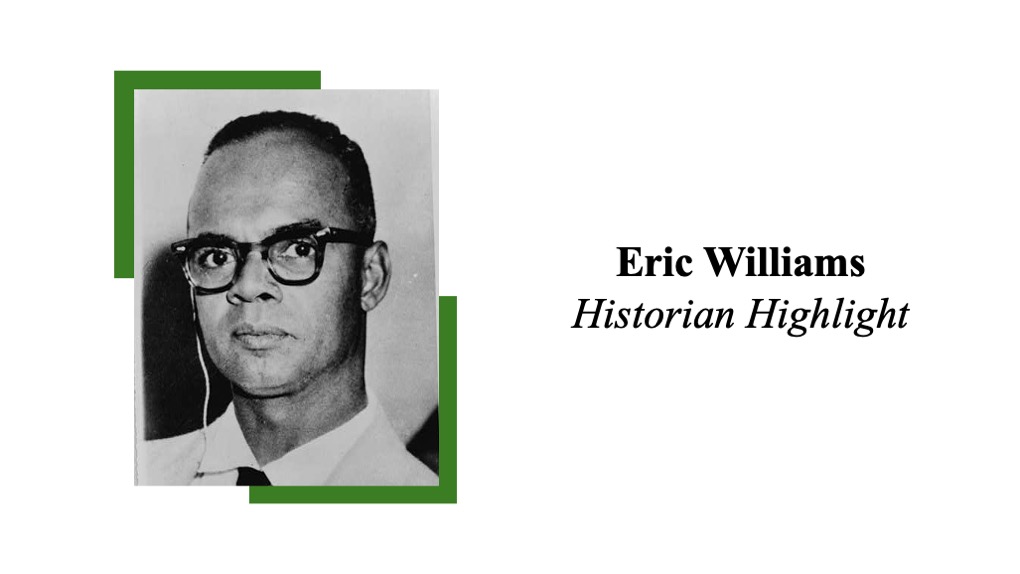
On 19th April 1944, Eric Williams (1911-1981) delivered a lecture at Trinidad Public Library on ‘The British West Indies in World History’. Williams later recalled in his memoir how the audience overflowed the space of the library. He created typed copies of the lecture to sell cheaply so his paper could reach as many Trinidadians as possible. As time went on, his public lectures grew in popularity until the library became wholly inadequate at accommodating the crowds. Williams turned instead to the nearby Woodford Square; named after a previous colonial governor of Trinidad, Sir Ralph Woodford, in the past the square had been the site where rebellious enslaved people had been hanged. It was a poignant location for Williams’s lecture series that used history to argue for Trinidadian independence. The place where Williams gave his lectures became known as the University of Woodford Square.
The University of Woodford Square optimised Williams’s approach to public history; with no buildings, no tickets or enrolment required, near to the public library and to Parliament, the lectures reached Trinidadians from all social classes. Williams ‘made a point not to talk down to the people. It was university discourse in content and in form that was designed to place the problems of Trinidad in an international perspective’.
The Woodford Square lectures came at a key moment in Williams’s life, when he decided to leave behind an academic career to become a politician. He had been born and raised in Trinidad, before winning a scholarship to study history at University of Oxford. He remained at Oxford after his undergraduate degree and received his doctorate in 1938. The following year he emigrated to the US and joined Howard University.
However, he became increasingly involved in politics. By 1956, he announced to the crowd gathered at Woodford Square that he would be founding his own political party, the People’s National Movement (PNM). At the helm of the PNM, Williams led Trinidad and Tobago to independence in 1962 and became the first prime minister of the country.
As an historian, Williams is most well-known for his 1944 book, Capitalism and Slavery, which arose from his doctoral thesis. Williams described his work in a preface as, ‘strictly an economic study of the role of Negro slavery and the slave trade in providing the capital which financed the Industrial Revolution in England and of mature industrial capitalism in destroying the slave system’. Williams decisively connected Britain’s wealth with its historical exploitation of African enslaved labour. He also controversially argued that Britain had abolished slavery not due to humanitarian, moral, or religious sentiments, but for economic reasons, as slavery was no longer profitable. While other historians have since emphasised slavery’s profitability right up until the moment of abolition, Williams is still considered the first historian to unseat the patriotic, heroic narrative of British abolitionism, acknowledging more pragmatic motivations underlying the British antislavery movement.
Another of his books, The History of the People of Trinidad and Tobago, brought together much of the content of Williams’s Woodford Square lectures, using the history of the islands to bolster their national identities and anticolonialism. The history was, Williams wrote, ‘the story of the misrule of metropolitan bureaucracy and the indifference of metropolitan scholarship’.
Williams remains an example of a thinker whose historical research both powerfully challenged academic orthodoxy and contributed to major political change. In his careers as an historian and as a politician he resisted imperial power and Eurocentric historical narratives, in ways that inspired later generations of scholars and activists alike.
Further Reading and Bibliography
Shields, Tanya L. (ed.) The Legacy of Eric Williams: Into the Postcolonial Moment (Jackson: University Press of Mississippi, 2015)
St. Pierre, Maurice, Eric Williams and the Anticolonial Tradition: The Making of a Diasporan Intellectual (Charlottesville: University of Virginia Press, 2015)
Williams, Eric, Capitalism & Slavery (London: Andre Deutsch, 1964 [first published 1944])
Williams, Eric, The History of the People of Trinidad and Tobago (New York: Frederick A. Praeger, 1964 [first published 1962])
Williams, Eric, Inward Hunger: The Education of a Prime Minister (Princeton: Markus Wiener Publishers, 2006 [first published 1969])
 doinghistoryinpublic.org