

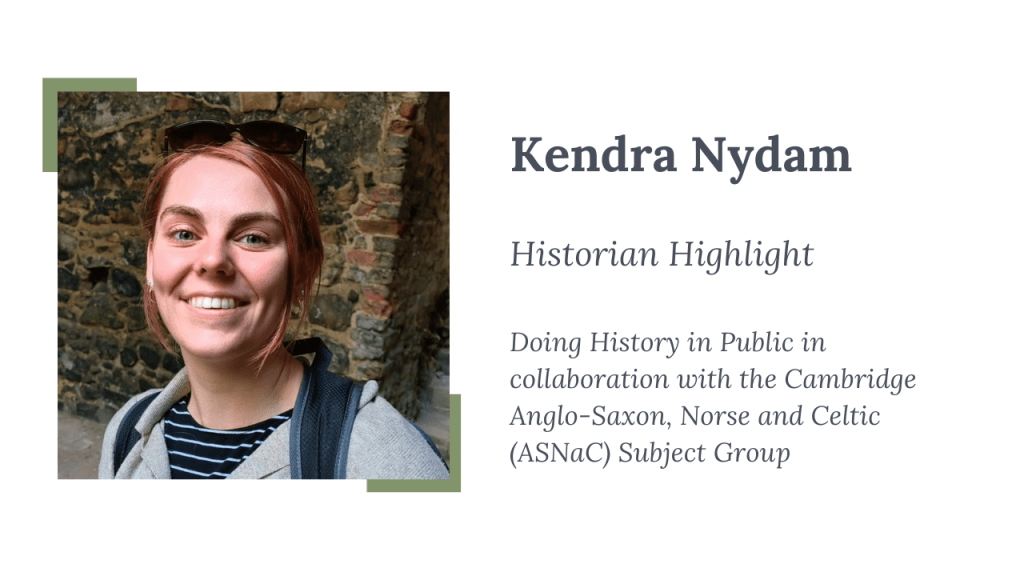
Kendra Nydam and Chris Campbell
University of Cambridge
A new academic year brings with it a new editor for our Historian Highlights section and, as has become tradition, we introduce them to you through the form of an HH interview.
Chris Campbell, the outgoing editor, sat down earlier in the summer with Kendra Nydam, a second-year PhD student to discuss Norwegian and Icelandic medieval history, interdisciplinary approaches to historical research, and the differences between American and British higher education.
Kendra, let’s start by talking about your research:
I’m based in the department of Anglo Saxon, Norse, and Celtic (ASNaC), and I’m mostly looking at texts that come from twelfth and thirteenth-century Norway and Iceland, though many of the narratives recorded in these texts, whether historical, fictional, or somewhere in between, concern events of the Viking Age (approx. 800-1050 CE), Icelandic Saga Age (from the settlement period starting around 874 to roughly 1056 CE) or even contemporary events that occurred during the authors’ own lives. I’m particularly interested in father-daughter kinship dynamics, how those relationships are represented by thirteenth-century writers, and tracing how those representations vary or stay consistent across different genres of literature written in two very different but interconnected socio-political arenas of thirteenth-century Scandinavia. I try to take a more interdisciplinary approach to my research, particularly using the tools of anthropology.
Tell me a bit more about these kinship dynamics – how do they appear in the texts you’re looking at.
In my first year, I focused a lot on early Norwegian literary and historical texts, mostly written between the late twelfth and thirteenth centuries. They were written with a particular audience in mind, which clearly affects the representations of the people in them. So, most of them fall within a genre that we call the Kings’ Sagas (Old Norse: konungasögur)– very much focused, as the name implies, on royal Norwegian figures, and specifically tracking a line from the earliest Norwegian royalty down to the contemporary thirteenth-century period when the largest amount of them were written. Looking at daughters of royalty within that context, they very much tend to be secondary figures in the background of the narrative. As literary figures they’re sidelined or, if they’re prominent, they tend to be vilified or only exist to the serve the purpose of elevating the status or image of a protagonised male figure. Yet they still make an appearance, and have an important political role to play, which is where the anthropological side of things comes in: using that approach, we can more clearly see the vital kinship function of these women in the economic system and rigid social structures they were working within.
How many of these texts have survived, and is it possible to draw a less elite focus from them?
Surprising numbers of these texts survive, or, where they don’t survive in their original form, we have copies of earlier manuscripts that we know existed or references to them in other surviving texts. A lot of the more literary texts – such as eddic poetry and possibly even some of the Icelandic sagas – began in the oral tradition and were transcribed later on, which really fascinates me because sometimes you have multiple written versions or traditions of a particular narrative that must at one point have had a common source, but were changed and differentiated over time in order to fit the new written medium or as a result of a particular author’s focus or priorities within their version of the story.
Even so, it’s difficult to make the focus less elite, particularly when talking about Norway, because the condition of the lower classes or anyone not attached to the Norwegian nobility was not the focus or the point of the Kings’ sagas. Most of the texts, like the Norwegian synoptic histories, specifically surround royal or heroic figures – people who were set up by a text’s author to be idolised. In the thirteenth century especially, which is the focus of my thesis, they were interested in using these texts to trace ideas of Norwegian identity, its earliest and most prominent kings, and state-building. The daughter figures present in these texts are quite restricted compared to daughters in other genres I will be researching, and thus are not a group of women whose experiences can be seen as ‘typical’ to all women of their time.
This year, though, what I’m hoping to do is look much more at the Icelandic sagas – particularly the ‘contemporary sagas’ written by or about 13th century people and events – where the focus tends to be less on kings and more on localised Icelandic heroes, chieftains, or leaders. It’s still stories of ‘the elite’ of thirteenth-century Iceland, but it does get a bit closer to the common man. You get more glimpses and episodes of what lower classes are up to and how they’re affected by the actions of those at the top of society. Women makes some very noteworthy appearances in the sagas and how this behaviour plays into their identity as daughters within the larger kinship structure deserves much more attention than scholarship up to this point has given them.
So, you’re looking at this from a historical perspective, but you’re bringing ideas from anthropology and literary studies into your reading of these sources – how is that shaping your research?
When we look at ideas about kinship in the field of Old Norse literary studies, the family emerges as something that was central to Old Norse society, from the Viking Age into the early Middle Ages. The family is a very important structure from a dynastic, economic and domestic standpoint, and understanding how people are exchanged and related to each other within that structure is crucial. New developments in anthropology really help to unpack this; in the past, researchers in this field tended to either focus on descent and consanguinity (blood relation) only or take a very structuralist, binary approach to families and kinship, because Viking Age and early medieval Scandinavians appeared to be very structured societies with clear-cut kinship roles. But what I’m gradually finding is that, even though there were very established ideals for gender and familial roles, when those roles were put under stress – such as in the tumultuous period before the Norwegian civil wars or right before the end of the Icelandic Commonwealth in 1262 CE– the whole thing suddenly becomes much more permeable and flexible and the daily social practice was likely more situationally dependent. What I’m discovering is that when the structures of a patriarchal society break down, either because the men get killed or put out of action, then so much of the responsibility falls on the women to keep the family going, and to ensure it survives into the next generation. So women that can appear to take a back seat in genres like the Kings’ sagas suddenly become hugely important and fully centralised in narratives concerning societal or social breakdown.
With that interdisciplinary focus, I’m curious to know how you would describe your academic identity – would you say you’re a historian based in ASNAC, or an anthropologist doing literary and historical research, or something else altogether?
It’s a really good question, because I’ve never seen literature and history as two separate things. Often, I think literature is one of our best records of a culture in a particular time period and place; when people put ideas on a page, they’re talking about things they truly care about. So if you want to get on the pulse of a certain culture in a certain period, read their literature, because that gives such a good sense of what people were talking and thinking about, and it’s where political arguments are laid out for the general populace. It’s also really interesting to see class divides, or the breakdown of class divides, that can happen through literature. You can get things written in medieval Latin, or ecclesiastical sources where only a very elite, select group of people would have had regular access to them, and then you can get texts like the Icelandic Sagas, usually written in vernacular Icelandic and accessible to more ‘ordinary’ people. All of that diversity in sources, uses, and perspectives gives you such a good idea of a society and a culture in a particular time and place: at least, through one particular author’s eyes.
How did you arrive at this topic, and your interdisciplinary method?
I’ve always had a fascination with the earliest parts of a culture’s history, and how different cultures develop over time. I went to a very small undergraduate university in Iowa, and I still remember a class where we read an Old English poem called The Dream of the Rood – everyone else was falling asleep and I was sitting forward, so I took that as a sign that maybe I should keep pursuing this.
I was always planning to go on to graduate school, but I graduated in 2020 which was not a good year, for obvious reasons, so all my plans flew out the window. I taught high school literature, history, and world religion for a few years, and then I applied to Oxford and Cambridge for a Master’s. Cambridge was my first choice because the ASNAC department is so unique, and I really love the interdisciplinary aspect to the studies there. Everyone who goes through the department has to have a language component to their studies, so along with learning the history, archaeology and literature of the culture we specialise in, we’re also learning the languages that our manuscript sources were being written in. Because I study medieval Icelandic and Norwegian history, I have to do my competencies in Old Norse language too. I have to be able to read my sources in the language they were originally written in, and you don’t get that opportunity for such in-depth study in every place.
How have you found the experience of doing a PhD at Cambridge?
Jumping in to the whole Cambridge system, as an American, at times can make you feel a bit like a fish out of water, but in general it’s been a really great experience for me because there’s such a richness to the academic life here that I wouldn’t have had if I’d stayed in the States. It feels a bit like learning another language but, as we’ve probably already established, I like doing things like that. There’s just something very cool about seeing how education functions in a different place. The US and UK have such different approaches, but we can definitely benefit from both.
It must be interesting to bring a kind of anthropological insight to bear on a different educational structure.
Yes! I have found that American education tends to lend itself to cross-disciplinary study, and it’s much more common – even in our general liberal arts degrees, we’re forced to take classes in different subjects. When I was an undergrad I took science courses and statistics; I think there’s something very valuable about that – it gives you a different perspective on things. At the same time, coming to Cambridge, it’s just really fun to be able to focus specifically and narrowly on something I’m really fascinated by, and uncover how many possible layers there are to a single topic. Even within a very niche subject like ASNaC, there’s so much room left to explore. I keep thinking there’s got to be an end to this very narrow field I’m in, but I just find that the doors keep opening wider and wider.
 doinghistoryinpublic.org
Leave a comment