

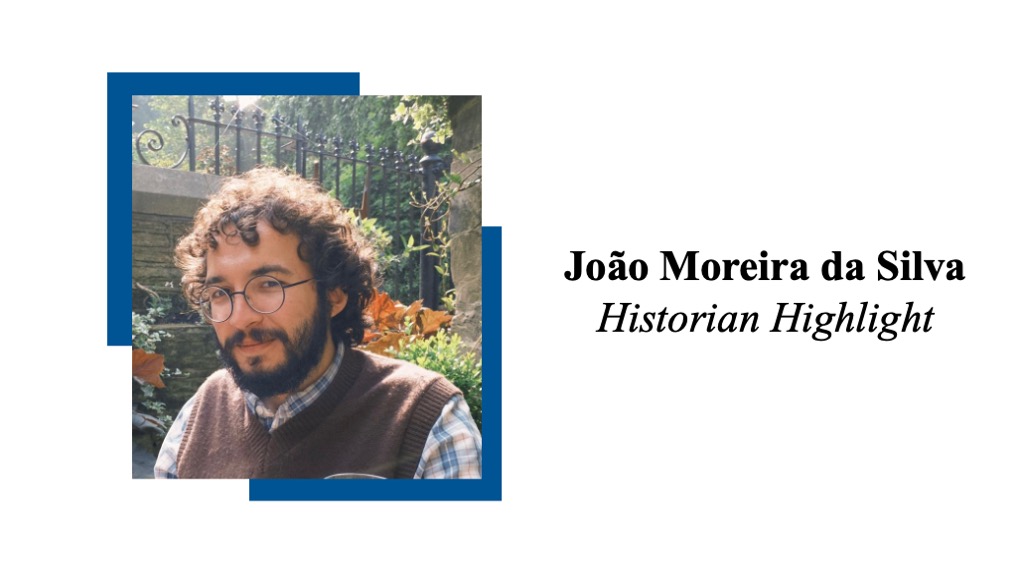
Historian Highlight is an ongoing series sharing the research experiences of historians in the History Faculty in Cambridge and beyond. In this instalment, Chris Campbell sat down with second-year History PhD student João Moreira da Silva to talk about his research on the Portuguese Empire and its colonial legacies.
João, let’s start by talking about your PhD research.
My research is on the Portuguese Empire in the nineteenth century. More specifically, I look at the islands of São Tomé and Principe in the Age of Revolutions – so, I’m exploring ideas of empire and anti-colonial insurgency in the context of a plantation society.
How did you come to this topic?
During my master’s at SOAS, I studied an intellectual from the early twentieth century called Mário Domingues. He was born in Principe, and he was the first African-born intellectual in the Portuguese Empire to put forward the proposition for African independence. From looking at his work and its relationship to the plantations in São Tomé and Principe, I decided for my PhD to look at the construction of this plantation system where he was born. This has meant moving beyond pure intellectual history and thinking about the intersections of political, environmental and legal history – although, I do still enquire into ideas of Enlightenment, ideas of agrarianism, and ideas of revolution emerging in the Atlantic during those years.
What are the archives like for your research?
I was quite scared of my archive at first, because it’s so big and I wasn’t sure if I would be able to understand the sources or even read the handwriting. But it’s been a very pleasant surprise because, after getting used to it, I was able to trace histories of Santomean insurgencies against the Portuguese, which I was very surprised to see. There are many different moments I’ve found in which the Empire was directly questioned and resisted by this African population, which contemporary historiography on the islands has greatly overlooked. We usually talk about silences in the archives, but this wasn’t silent at all.
You mentioned Eric Hobsbawm’s framing of the Age of Revolutions. How does that wider concept fit into your research?
Initially, this was supposed to be a project on the assemblage of the plantation system in São Tomé, which took place at the end of the nineteenth century. But, once I went to the archive, I realised that in order to study that properly, I would have to go back to the beginning of the century, which places it in the so-called Age of Revolutions. I’ve realised that ‘revolution’, as an intellectual idea, is a very important part of this history; Santomeans often appropriated and reinvented global ideas of revolution to criticise the Portuguese colonial apparatus, which in turn was fearful of an African revolution that mirrored the case of Haiti.
British history and British society is still grappling, sometimes in publicly contentious ways, with the legacies of empire. How does the Portuguese context differ, and how does your research engage with those issues?
My research is definitely moved by discussions that are happening now. I think that colonialism shaped questions of power and resistance, and the effects of that are visible in Portugal today. But, in Portugal, public discussions and actions from public institutions on this topic are falling behind. For example, the discussion on reparations, which is growing worldwide, is still very much ignored there. Countries like São Tomé and Principe, and Cape Verde, have both started talking about reparations from Portugal, but the Portuguese government has ignored them and organisations like the African Forum and CARICOM. So I guess my research, and the research of my colleagues back in Portugal, is rooted in trying to tackle this issue. Colonial legacies in Portugal should be addressed and questioned through history writing; that’s one of the main objectives of my dissertation, really – to not only write a history of São Tomé but also a history of how Portugal was shaped by colonialism.
On the subject of colleagues, who are some historians who inspire your work?
Actually, a lot of the people who have been really influential in my work so far aren’t technically historians; they tend to be anthropologists, sociologists, cultural critics and so on. I draw on historians, of course – Eric Hobsbawm, as you’d expect – but I’m really inspired by people who address colonialism by working at the intersections of politics, anthropology and history – people like David Scott and Ann Stoler, or the political theorist Timothy Mitchell. There are also two Portuguese historians I’d like to mention, because they aren’t very well known in the UK. One is Valentim Alexandre, and also Isabel Castro Henriques, who’s written a lot on the Portuguese Empire. She’s greatly influenced me since I was very young, because she’s actually my grandmother!
Historical research runs in the family, then. Can you tell me a bit more about your grandmother and her work?
She studied African history in Paris during the last years of the Portuguese dictatorship. After the 1974 revolution, she started giving lectures in Portugal and actually founded the first course on African history there. She’s always been researching and teaching histories of slavery and empire in West Africa, so a really clear influence on what I do now.
That must give you an interesting link to an older historiographic tradition. How has it changed from when your grandmother started writing about the Portuguese Empire to now?
There’s been a definite shift, and this is a debate that relates to the broad field of African colonial studies. I guess the questions that we’re trying to answer nowadays are different from the ones historians like my grandmother were trying to answer in the 1960s and ‘70s. Back then, people who were doing African history were mostly trying to retrieve the history of Africa, in the sense that they were answering to Hegel’s claim that Africa has no history because it has no written sources – which is clearly not true, and that’s been well asserted over the years. Our generation is no longer trying to do that work of equalising the historical record, but rather looking at specific histories, local histories, global connections and shaping it into an explanation of how the past informs the present.
Thinking about that new generation of historians, what has been your experience of doing a PhD at Cambridge, and the PhD research culture here?
It’s been very interesting because, to my knowledge, nobody at Cambridge is really doing any research on São Tomé and Principe, or even on the Portuguese Empire in Africa. So that means there aren’t many people I can talk to about the specificities of the place I’m studying, which can have its downsides. But the upside to that is that it forces me to engage with other people’s work that is very different geographically. And through things like the World History Seminar and Workshops, I’ve come across many similarities to the São Tomé case in work being done on Hawaii, Sri Lanka, the Caribbean, and so on. It’s really helped me think more broadly about my topic and bring in other methodologies, theories and framings – the Age of Revolutions is a good example of that. It has a long tradition in Cambridge, from Hobsbawm and Bayly, to Sujit Sivasundaram and Christopher Clark today, which has deeply influenced me; it’s not a framework that’s usually employed for the Portuguese Empire in Africa, but being in Cambridge has helped me bring the two together – I hope with interesting results.
Finally, what kind of advice would you give to someone starting out on their PhD?
Read outside of your historical field and, even more than that, read outside of academic work. Don’t stop reading novels, watching films, viewing creative things. I find that seeing other peoples’ creativity helps me have new ideas, helps me with my writing, and helps me put new thoughts together.
 doinghistoryinpublic.org