

by Sophia Feist
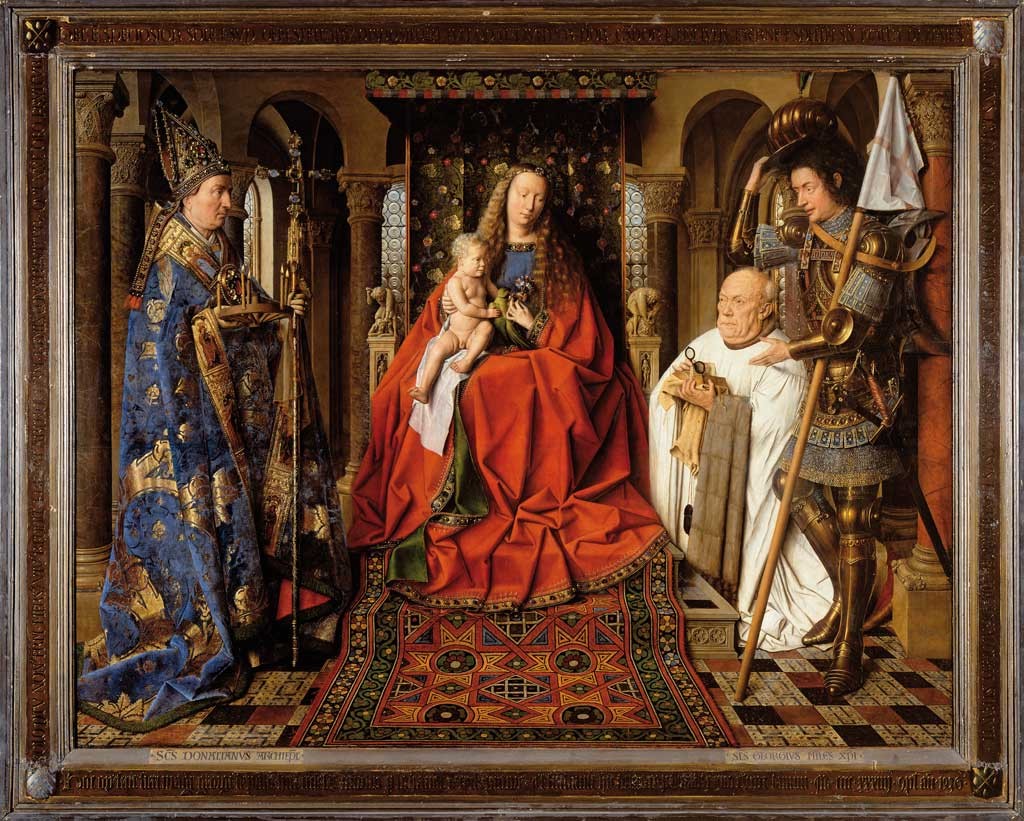
Cover Image & Fig. 1 – Jan van Eyck, The Virgin and Child with Canon van der Paele, oil on wood, 141 x 176.5 cm, Groeningemuseum, Bruges (Photo: Wikimedia Commons)

One of my favorite paintings is Jan van Eyck’s The Virgin and Child with Canon van der Paele (1434-1436). One of my favorite details in that painting is the blue and gold velvet brocade worn by St. Donatian, to Mary’s right. It’s painted so finely that you can see the individual gold threads in the weave- just look at the image!
These days, a piece of handwoven silk velvet will run you somewhere between €1,500 (£1,280) and €5,000 (£4,290).[1] That piece will be a meter long and just over half a meter wide- enough to make a pillowcase or a very short miniskirt. The price comes from the materials, but also the huge amount of skill and labor involved. I’m telling you this not as part of a diatribe against fast fashion (though I’m always ready with one!) but to give you some idea of how highly valued silk velvets were in the 1400s, especially brocades with gold woven in and the pile (the furry surface) cut to different heights.

The expense and skill required to make velvet made it a status symbol, worn by kings and popes, and a valuable trophy of battle.[2] Battle is how a tabard of blue and gold velvet brocade wound up in the Altes Zeughaus, or old armory museum, in Solothurn, Switzerland. This blue and gold velvet brocade was captured from Burgundian troops by Swiss mercenaries.[3] It looks so much like the brocade in Jan van Eyck’s painting that I stopped in my tracks when I saw it. The textile was almost certainly made in Italy, but it was used in Burgundy, where Jan van Eyck painted.
Be honest- if I hadn’t told you, could you tell which photo is real brocade and which is painted?
References:
[1] Deb Essen, “Spotlight: Tessitura Bevilacqua” Handwoven Magazine, December 23, 2019, https://handwovenmagazine.com/spotlight-tessitura-bevilacqua/#:~:text=The%20plush%20velvets%20range%20in,voided%20velvets%20average%20%E2%82%AC5%2C000.
[2] Anna Muthesius, “Silk in the Medieval World”, p. 325-354, The Cambridge History of Western Textiles ed. David Jenkins (Cambridge: Cambridge University Press, 2003), p 325.
[3] Museum Altes Zeughaus, “Burgunderbeute, Tagsatzung und Probierharnisch.” May 25, 2020, video, https://museum-alteszeughaus.so.ch/museum/museum-fuer-daheim/kurzfilme-ueber-das-museum/
 doinghistoryinpublic.org