

By Amy Craig
Like opening up the little doors of an advent calendar, swinging open the front segments of the c.1760 Blackett baby house reveals a world of tiny treasures contained within. Rather than playthings meant only for children, eighteenth-century dolls’ houses, or ‘baby houses’ as they were known by contemporaries, were used and cherished by adults and children alike. This example, now in the Museum of London, originally belonged to Lady Anne Blackett of Matfen Hall, Northumberland.

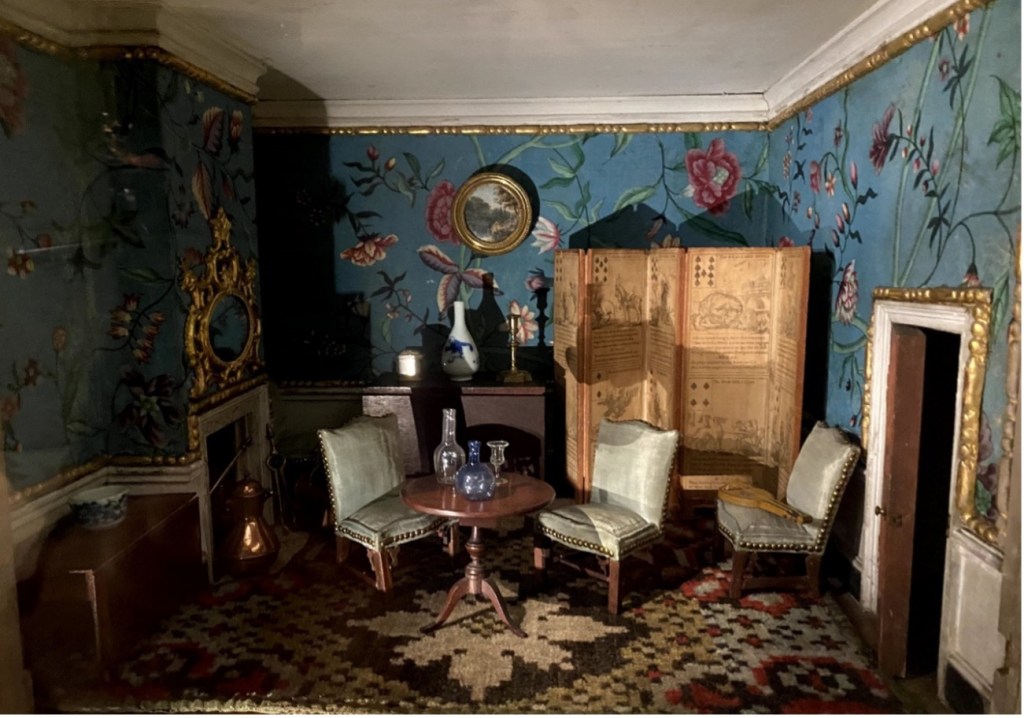
Spanning four floors, the Blackett baby house features both a basement and an attic (accessible by secret side doors!) as well as four main rooms: a kitchen, dining room, bedroom and drawing room. Carefully created and curated by their female users, the baby house would have acted as a strong expression of owner Lady Anne Blackett’s worldly knowledge and refined tastes. The walls of the first-floor rooms, for example, are lined with a highly fashionable Chinese-style floral wallpaper, the largeness of its design suggesting that it was perhaps repurposed from a full-size sample. The grand four-poster bed was another status symbol, complete with two mattresses, linen sheets, wool blankets and silk taffeta curtains hung by tiny rings from a rail beneath the tester.[1] Indeed, this was a true home in miniature, with the Blackett baby house even featuring a working spit roasting mechanism above the kitchen fireplace, and fully functional silk window curtains.[2]


Personalising baby house interiors represented a life-long project for eighteenth-century, elite women. The miniature screen in the drawing room of this house, for example, has been decorated with reproduction prints of a set of playing cards. Illustrating the well-known Aesop’s Fables, these cards were from a pack on sale at John Kirk’s toyshop in St Paul’s Churchyard, London, during Christmas 1759.[3] Customised with a rather festive souvenir, this little screen was an entirely unique creation, as was the small-scale space to which it belonged.
Cover Image: Drawing room of Blackett baby house, England, c.1760, mixed media, Museum of London, 37.13/1, author’s photograph.
References:
[1] Museum of London object summary for ‘Miniature bed’, 37.13/141, https://collections.museumoflondon.org.uk/online/object/755850.html, [accessed 30 Nov 2023].
[2] Museum of London object summary for ‘Baby house’, 37.13/1, https://collections.museumoflondon.org.uk/online/object/755643.html, [accessed 30 Nov 2023].
[3] Museum of London object summary for ‘Miniature screen’, 37.13/112, https://collections.museumoflondon.org.uk/online/object/755769.html, [accessed 30 Nov 2023].
 doinghistoryinpublic.org
One response to “8. Inside An Eighteenth-Century Dolls’ House”
Wow so interesting!