

By Daniel Gilman, @DanielGilmanHQ
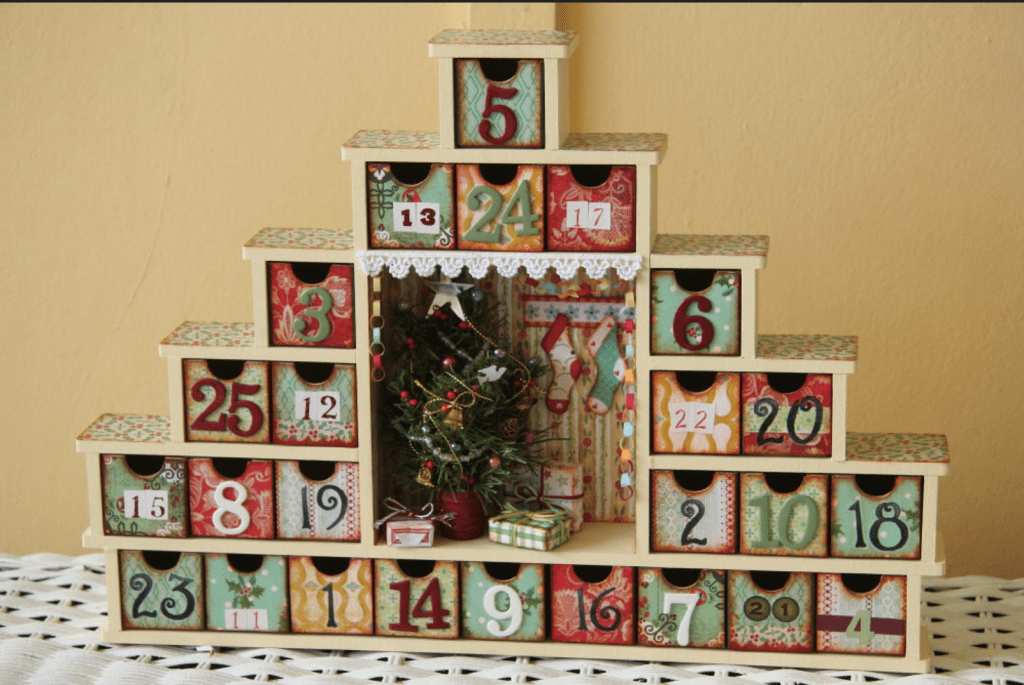
Ever wondered about the Advent calendars history, from its origin as a religious countdown to Christmas, to its present-day iteration, featuring little surprises behind little cardboard doors? You’re not alone. Here is what I’ve found as I traced the history of Advent calendars for Doing History in Public.
Public history enables us to engage with these questions, treating everyday objects like Advent calendars as artefacts of material culture. I’ve learned a lot from my former colleague Alex Wakelam’s exploration into this subject; let’s dive deeper to understand what these calendars reveal about cultural shifts in society—through the lens of public history.
Canadian philosopher Charles Taylor provides a framework for understanding these transitions. He differentiates between an ‘enchanted world’, imbued with spiritual significance, and a ‘disenchanted world’ focused on material realities and secularisation.[i] Initially conceived to spiritually prepare individuals for celebrating the birth of Jesus, companies seized upon the possibility of disenchanting Advent calendars into a myriad of commercial offerings.
From a sacred ritual to a secular phenomenon, the Advent calendar has changed since its early 19th-century origins among German Lutherans, who marked the days leading up to Christmas with chalk or candles. 1851 saw the debut of the first wooden, image-based calendar in Germany.[ii] Printed versions appeared between 1902 and 1908, while Gerhard Lang’s 1920s innovation added interactive doors.[iii]
The tradition paused during World War II due to Nazi restrictions but was resurrected post-war by Richard Sellmar.[iv] The late 1950s introduced chocolate-filled versions and global spread, partly fuelled by a presidential endorsement from Dwight D. Eisenhower.[v] Fast-forward to the 21st century, and the calendars have diversified to feature Harry Potter toys, mini-books, and even beauty products, costing £699.99 on Amazon.
By analysing Advent calendars as a primary text of material culture, we can explore their capacity to signify our complex negotiations between religious traditions and contemporary consumerism. The term ‘Advent’ itself, lingers as a vestige of Christian theology, indicating that here secularisation reconfigures without completely erasing religious frameworks.
Advent calendars serve as unique touchpoints for exploring public history and material culture. They encapsulate changing attitudes toward spirituality, secularisation, and materialism in modernity, offering an accessible and relatable avenue for the public to engage with complex cultural narratives. So, the next time you discover a tiny treasure behind a calendar door, remember you’re not just indulging a holiday fancy—you’re engaging with a living piece of public history. I hope you’ll enjoy getting ready for the holidays as you read our daily Advent blogposts.
Happy Christmas!
References:
[i] Taylor, Charles. A Secular Age (Cambridge, MA: Harvard University Press, 2007), 25-26.
[ii] Wakelam, Alex. “The history of Advent calendars.” Doing History in Public. Accessed on [Accessed 20 October 2023]. https://doinghistoryinpublic.org/1-advent-calendars/.
[iii] Forsyth, Mark. A Christmas Cornucopia: The Hidden Stories Behind Our Yuletide Traditions. London: Penguin Books Limited, 2016, 34.
[iv] Harding, Margie. Christmas Countdown: Creating 25 Years of New Advent Traditions for Families. Dulles: Paraclete Press, 2010, 58.
[v] Rowsell, Susan. Christmas Around the World: An Advent Book. Altona: FriesenPress, 2020, 43.
 doinghistoryinpublic.org
One response to “1. Count Down Through Time: The Advent Calendar as a Primary Text for Public History”
[…] The first Advent calendars were simple chalk marks on walls or doors. In one account, their creation is attributed to a Munich mum worn out by her excited, waiting kids asking – over and over again – when was Christmas coming. […]