

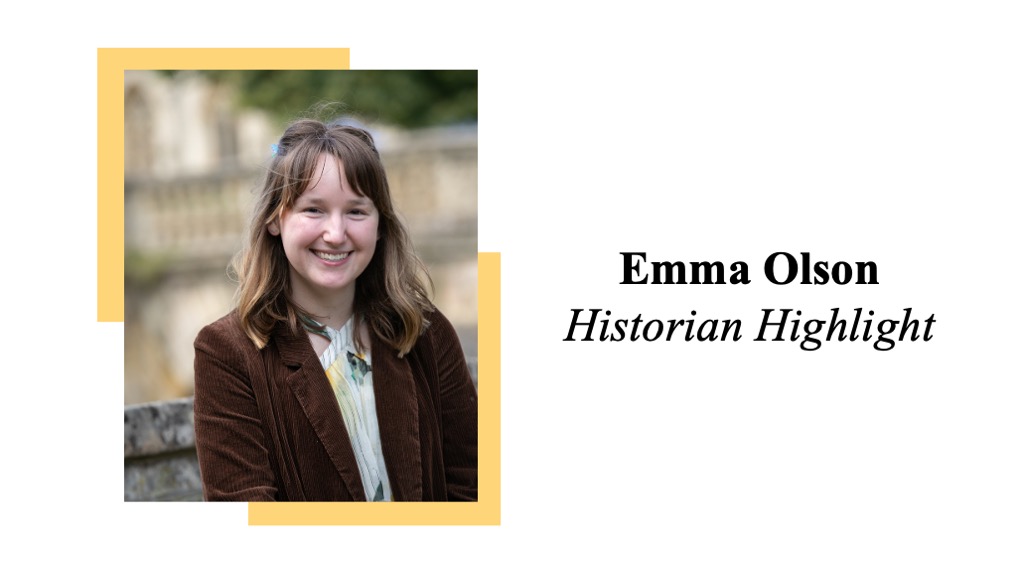
Historian Highlight is an ongoing series sharing the research experiences of historians in the History Faculty in Cambridge and beyond. Earlier this month, Chris Campbell met up with second-year History PhD student Emma Olson to discuss soundscapes, religious violence and the challenges of researching medieval history.
Emma, tell me about your current research
I work on the soundscapes of medieval Spain, and specifically a kingdom called the Crown of Aragon, which stretched from Perpignan in modern southern France all the way down to Valencia. What’s really interesting about this region is that it had remarkable inter-faith mixing in its communities, which has become the topic of a ton of scholarship on Iberia, studying how Muslims, Christians and Jews all lived in the same cities, the same kingdoms. I’m interested in questions of co-existence and violence through soundscapes – thinking about how sounds like church bells, the Islamic call to prayer, sounds of Jewish worship, all sat together, and then how those sounds were policed and regulated. I’m exploring what that can tell us about relationships between different groups and within communities, and more generally the relationship between sound and violence – how violence can be inspired by sound. There’s also a methodological dimension to this project, which asks how we approach and understand sound in a period that doesn’t have tape recorders, where it’s only written about and described in text.
And how did you come to this topic?
I studied Music at undergrad in the US. I came to History through Musicology, and through Performance History. I always knew I wanted to do something with histories of performance, and then I discovered sound studies through a really influential professor who introduced me to medieval history. Not very many people work on medieval sound studies because it’s so difficult. I’m interested in showing how medieval people might not have understood what wavelengths and frequencies were, but they still understood that they could use sound to cause harm or to create good. They understood the power of sound.
So, your background is Music, but how did you find the transfer to History having never studied it before?
I came to History via Medieval Studies, which is a much more interdisciplinary subject. In the US, there are Medieval Studies departments that draw people from different faculties like Music and Literature; I did my master’s in one of those, so I had time before I had to pick a disciplinary home. I ultimately decided I wanted to be in History because I thought that the answers to my questions lay more in historical archival sources than in musical or literary sources.
Your research is very rooted in inter-faith conflict, but also opportunities for exchange. How do you see the importance of your research fitting into current dialogues on that issue?
I’m really lucky to be funded by the Woolf Institute, who are great at bridging historical research – scholarship of any kind, actually – with modern problems and issues in inter-faith relations. They’ve really encouraged me to be constantly thinking about that. I guess one useful thing to modern issues from my research is that it shows the importance of not listening to just one source or perspective; you have to triangulate things to get the bigger picture about how faiths relate to each other. Looking at sound, looking at different listening practices, helps contextualise lived experiences in a way that’s really relevant now, because you still get these same conflicts over religious sound – Switzerland, I think, doesn’t allow the call to prayer; after 9/11, there were lots more complaints in America about sounds of Islamic worship. Understanding how these issues replicate and are handled across history is so important.
What are some of the challenges that are unique to your approach?
Sources. Most of my first year of the PhD was spent figuring out my sources, and that’s also usually the first question people ask when I talk about my project: what are my sources? I’m lucky because my geographic region has some of the most amazing archival survivals for the Middle Ages. The Crown of Aragon was obsessive about keeping records, and they had a huge supply of paper which allowed that. So, their archives are some of the largest surviving medieval archives in Europe. It’s also very daunting because they’re difficult sources to read and they’re not usually catalogued; it’s like searching for a needle in a haystack. But then it’s also very rewarding because when you do find that one perfect source that talks about sound, there’s nothing like that feeling. And getting to touch things that no-one has touched in hundreds of years is also very exciting.
Do you do any reconstructive history?
I guess in some ways it’s all reconstructive, but I intentionally don’t do reconstructive sound studies because I’m more interested in what sound did and how people used it, rather than in what something sounded like. I think that’s just a much more interesting question. It’s taking it a step further than reconstruction – what something sounded like is the most basic question, and then you have to ask questions like who described that sound, and why they described it in that way.
Who are some of the historians or scholars who have influenced your work?
I mentioned my undergrad advisor, Carol Symes, who is this incredible historian of performance. I wouldn’t be a historian, or a medievalist especially, if I hadn’t taken her undergraduate class – I was just blown away by the fluidity of medieval culture and how performance permeated absolutely everything. Her work is still the inspiration I go back to the most. There’s also a medieval musicologist called Emma Dillon, whose work I really admire – she was really the first person to bring sound studies to medieval history.
What’s been your experience of doing your PhD at Cambridge?
It’s been wonderful. Coming from the US, the thing I’ve liked the most is the community of medievalists – there’s just so many here, which is not the case at most US universities. Having that community to draw inspiration from has been huge for me.
And finally, what’s been your most exciting discovery in the archives?
The document I was most excited to find was a legal case where a monastery complained to a city council about a new synagogue being built so close to them. They were worried about the ‘polluting’ sounds of Jewish voices being too close. That was a very validating find for my topic, and I’m really excited to write about it.
 doinghistoryinpublic.org