

by David Martin (daim3@cam.ac.uk)
“Accompanied by hundreds of drums, trumpets, and all the discordant noisy music of the country; with numberless torches and fireworks: the statue of the Saint placed on a car is charged with garlands of flowers and gaudy ornaments according to the taste of the country… Such is the mode in which the Hindoo Christians in the inland country celebrate their festivals.”1
It was almost a comfort (to a certain subset of Christians, at any rate) that the old Catholic-Protestant rivalries were alive and well in eighteenth century South India. The Catholics were the first on the Malabar scene, but soon followed by the Protestants (and their recriminations). Certainly, the sentiments of the good Reverend Travis of Downton Abbey would fit perfectly if he were to say again that the Catholic “pagan folderol is not pleasing to our Lord”. And yet, it may surprise the reader to learn that the grand statement of anti-Indo-Catholicism in the opening quote was actually pronounced by a French Catholic Abbott — Abbé Dubois. Clearly there was something that the Catholics and Protestants agreed on; so one must wonder — why did missionaries, with all their zeal, spend their energies warring against groups who, logically, could have been their closest allies. So deep were these rifts that it seems even early Indian converts took them up and spent much of their time casting aspersions on one another. Though it begs the question, why in the vast Subcontinent of India would they not join forces to spread the ‘light of the Gospel’?
By the eighteenth century, Old Catholicism had already had a good two centuries to make its presence felt in the region. They had already founded some of the oldest and longest lasting European institutions in India, and had even managed a ‘Goa Inquisition’ (which no one expected). Eventually, their colony fractured and their (yet to be) City of Bombay had been ceded to Britain. Thereafter, a steady stream of European powers trickled into the Subcontinent, beginning with the heretical Dutch (who were just deciding to casting off the Spanish yoke), followed by the British (who could not be shown up by the Dutch!), the French (c.f. Britain), and the Danes (just because). No doubt, these intrepid adventurers would cast off the shackles of their Old World prejudices and embark on their spice quest with a spirit of true enterprise and camaraderie…
Alas, no.
The clusters of European colonies that peppered (literally and metaphorically) the South Indian coastline brought all their national angsts with them, creating a nice and neat replica of Europe in the tropics. Consider, for instance, the case of Bartholomäus Ziegenbalg, the venerable old pietist who made his way to Tranquebar under the aegis of Frederick IV of Denmark in 1706. After much diplomacy, this German missionary finally convinced his unwilling Danish hosts at Tranquebar to allow him to speak to the Indian inhabitants of British lands around Fort St. George who had been converted by the Portuguese of Goa and were subsequently served by the French priests of Pondicherry. Thus, with a solid base of Indian Christians to work with, it made sense for Ziegenbalg and his newcomer protestants to focus their efforts on attacking Catholics, rather than needlessly needling the non-Christians (which would have hurt European trade, further enraging Ziegenbalg’s hosts, who rather enjoyed having the church cats away). But what of the Indian converts themselves; where do they fit into this vibrant display of European hostility?
The answer seems to be that the Indians had been sitting on the sidelines with an amused expression on their faces. These first converts had joined Catholicism from the upper-echelons of Indian society and had been trained in South Asian forms of philosophy and theology. Many of the fine-grained theological debates from transubstantiation to theodicy that raged between Catholics and Protestants already had analogues in South Asia, which had been resolved (or at least dissolved) much earlier. As far as eternal salvation was concerned, Indian Christians knew the lay of that land, perhaps even better than their European counterparts.
Enter Vedanāyagam Sāstiriyār.
Young Sāstiriyār was among the first, and certainly the most famous, Indian protestants of the late eighteenth and nineteenth centuries. In addition to his work as a clergyman, he was a renowned poet and playwright who wrote some of the most beloved Tamil ‘Keerthanai’, or devotional songs, many of which stuck an almost combative tone. This was not against Hinduism (whatever that might mean in the eighteenth century) or Islam, but against Catholics, much to the delight of his Protestant colleagues, it must be said. Unfortunately, this delight did not last, and eventually, he had a falling out with the new(er) Protestant establishment in 1828.
This falling out had to do with the acceptance of the Caste System within the Church — as a Velalan, Sāstiriyār had a good position within the System, but was far from being a Brahmin (which would have put him at the very top). His Indian Catholic counterparts, on the other hand, were almost universally Brahmin converts who made the shift at a time when Portuguese Catholicism was itself very amenable to maintaining hierarchical systems, given their belief in the divine origin of such systems. Thus, when a new crop of British Evangelical missionaries arrived, who outright disavowed the Caste System, old Sāstiriyār was caught between a rock and an evangelical place.
By the end of the eighteenth century, both Catholicism and Protestantism had already taken on a distinctly South Asian flavour. What started off as tired old European religious rivalries had morphed and moulded itself into the shape of the Indian Caste System. As with so many questions of religion in South Asia, the issue, at heart, was Caste, not belief.
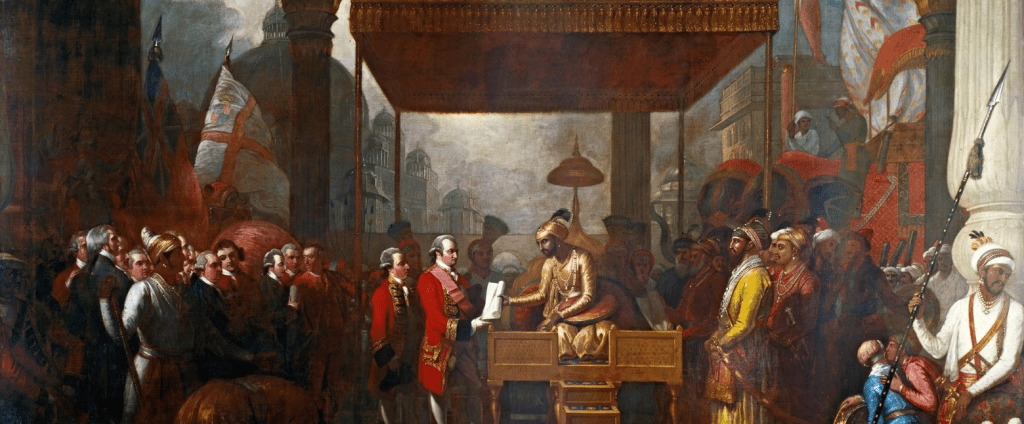
Cover image: Benjamin West, Alam conveying the grant of the Diwani to Lord Clive.
Further Reading:
- Ângela Xavier Barrero, “Languages of Difference in the Portuguese Empire. The Spread of ‘Caste’ in the Indian World,” doi: 10.15446/achsc.v43n2.59071.
- Dennis D. Hudson, Protestant Origins in India: Tamil Evangelical Christians 1706-1835, Routledge, 2001.
- Robert Frykenberg, Christianity in India: from beginnings to the present, Oxford University Press, 2008.
- Sheridan Gilley and Brian Stanley, The Cambridge History of Christianity: Volume 8, World Christianities c. 1815-c. 1914 (Vol. 8), Cambridge University Press, 2006.
- Abbé Dubois, Letters on the State of Christianity in India; in which the conversion of the Hindoos is
considered as impracticable. To which is added, A Vindication of the Hindoos, Male and Female in answer to a severe attack made upon both by The Reverend, 69-70. ↩︎
 doinghistoryinpublic.org
