


By Zara Kesterton (@ZaraKesterton)
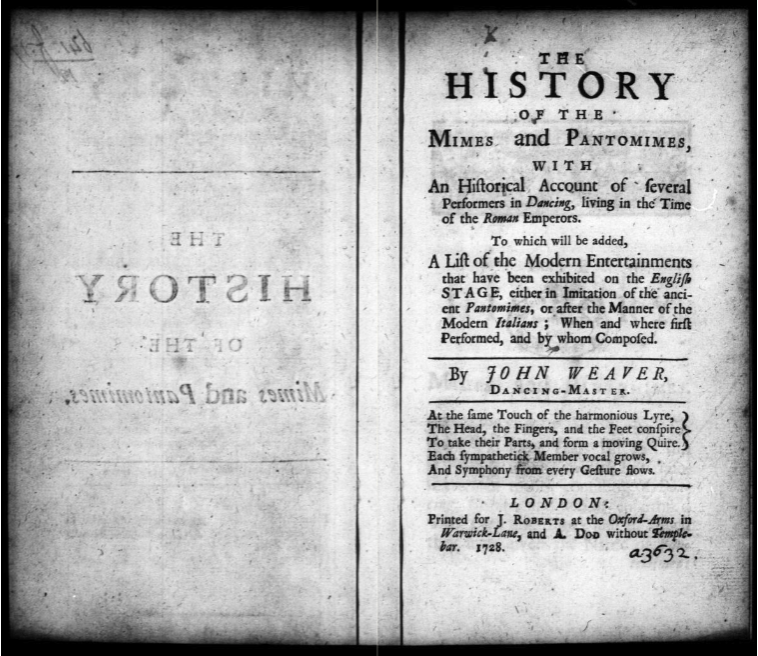
In 1728, the English dancer and writer John Weaver published The History of the Mimes and Pantomimes. Weaver has been widely credited with introducing the pantomime to England – although his pantomime of the eighteenth century is not what we would recognise today.
Audiences at a modern British pantomime expect a comedy show with songs and dances, drawing on a traditional tale such as Dick Whittington, Jack and the Beanstalk, Cinderella, or Sleeping Beauty. There is usually a pantomime dame (a man dressed as a middle-aged woman), and the main male character is often played by a woman. Audience participation is expected: viewers might need to warn a character that ‘it’s behind you!’, or challenge them with a cry of ‘oh, no it isn’t!’ or ‘oh, yes it is!’
For John Weaver, the important quality of pantomime was the art of telling a historical story without words, using only dance and graceful movements. Weaver saw true pantomime as descended from classical Greek and Roman mime performances, in which actors could ‘draw Tears from the Audiences at their Representations’ of emotions using only their bodily gestures.1 These were not supposed to be tears of laughter; Weaver disapproved of what he saw as the corrupted version of pantomime performed in Italy, known as Commedia dell’ Arte. Instead, Weaver argued that pantomime actors should study music, geometry, philosophy, rhetoric, painting, and sculpture – as well as knowing all of Homer’s works by heart – in order to perfect their performances.
Today, our concept of pantomime is closer to the Italian comedy tradition than the seriousness of Weaver’s art form. Many British pantomime traditions are actually derived from the nineteenth century, however. The Victorians introduced social satire to the pantomime, as well as cross-dressing for comedic purposes. The rising popularity of the Music Hall helped to shape pantomime into the extravaganza of song and dance that we know today. Weaver would probably be horrified!
References:
- John Weaver, The History of the Mimes and Pantomimes… (London: J Roberts and A Dod, 1728), p. 7. ↩︎
Further reading:
‘The story of pantomime’, V&A. https://www.vam.ac.uk/articles/the-story-of-pantomime
Fletcher, William George Dimock, ‘Weaver, John (1673–1760)’, Dictionary of National Biography, vol. 60,1885–1900. https://en.wikisource.org/wiki/Dictionary_of_National_Biography,_1885-1900/Weaver,_John_(1673-1760)
Orr, Bridget, ‘Galland, Georgian Theatre, and the Creation of Popular Orientalism’, pp. 103–130, in The Arabian Nights in Historical Context: Between East and West, eds. Saree Makdisi and Felicity Nussbaum (Oxford: Oxford University Press, 2008).
Weaver, John, The History of the Mimes and Pantomimes… (London: J Roberts and A Dod, 1728).
Cover image:
Set model, made 19th century. Victoria and Albert Museum, London, E.2087-1927. https://collections.vam.ac.uk/item/O1113504/set-model/
 doinghistoryinpublic.org